Rooster Aggression & Taming: Body Language Triggers, Flogging Prevention & Behavioral De-Escalation
Quick answer
Immediate Behavioral Answer: Rooster aggression (flogging, spur attacks, and charge attacks) is an instinctual territorial and hormone-driven behavior driven by testosterone peaks between 6 and 18 months of age. Roosters do not attack out of spite; they perceive human movements, bright clothing, or abrupt gestures as territorial challenges or predator threats to their hens. Early warning body language includes the tidbitting dance (sideways stepping with one wing dragged along the ground), intense direct eye contact, standing tall with neck hackles raised, and stamping feet before a physical flogging jump. To de-escalate and tame an aggressive rooster: never kick, hit, or run away from a rooster, as physical violence confirms you are a competing rival. Instead, carry a physical barrier (like a garden rake or plastic tote lid), calmly walk directly toward him until he yields personal space, pick him up calmly, and carry him tucked securely under your arm for 15 to 20 minutes while you complete coop chores.
Quick facts
| Primary Aggression Peak | 6 to 18 months of age, corresponding with avian testosterone surges |
|---|---|
| Early Warning Sign | Sideways waltzing with one wing dropped to the ground (tidbitting dance) |
| Flogging Attack Form | Leaping into the air, beating wings, and striking forward with sharp spurs |
| Critical Human Error | Running away (reinforces dominance) or kicking/beating (confirms rivalry) |
| De-Escalation Tool | Carry a physical shield (rake or bucket) and walk calmly into his space |
| The Taming Exercise | The 15 to 20-minute under-arm carry method during daily coop chores |
Rooster aggression and taming is one of the most common challenges faced by backyard flock owners. A cockerel that was docile and hand-fed as an 8-week-old chick often undergoes a dramatic physiological and behavioral transformation between 18 and 36 weeks (4.5 to 9 months) of age. Driven by surging plasma testosterone levels reaching 2.5 to 5.0 ng/mL, his avian neuroendocrine programming pivots toward defending territory, guarding 8 to 12 hens, and challenging perceived ground rivals within a 25-foot (7.6-meter) radius.
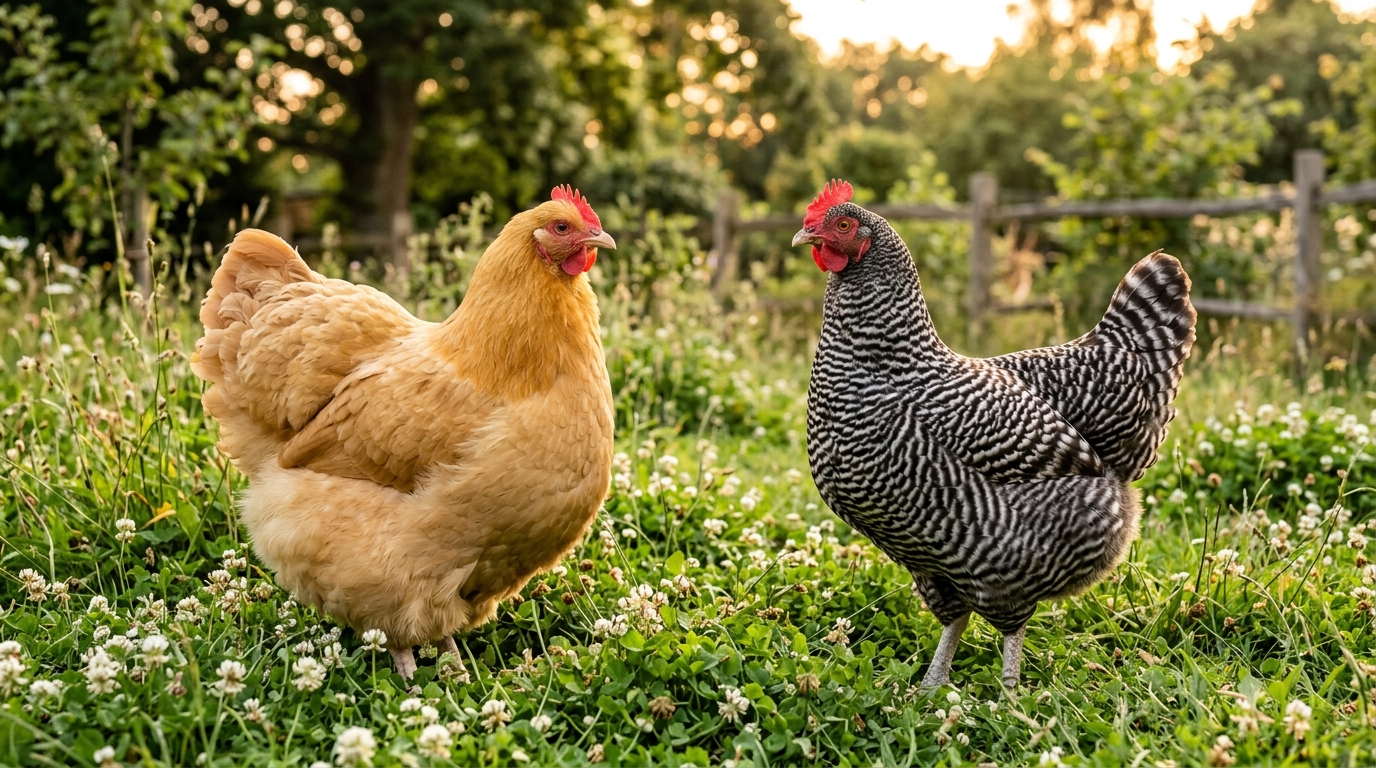
The Rooster Behavioral Escalation Ladder
| Escalation Stage | Observed Body Language | Rooster’s Internal State | Correct Keeper Response |
|---|---|---|---|
| Stage 1: Observation | Standing tall on toes, tilting head, following at distance | Evaluating keeper threat level and confidence | Ignore; walk purposefully through his territory |
| Stage 2: The Wing Dance | Sideways waltzing; dragging one wing along ground | Testing dominance boundaries and claiming authority | Walk directly into his path; force him to step back |
| Stage 3: The Threat Display | Flared neck hackle feathers, staring directly, head lowered | Imminent territorial challenge prepared | Square shoulders; hold garden rake shield to ground |
| Stage 4: Ground Pecking | Rapid, aggressive pecking at dirt or grass blades | Displaced aggression; building courage to attack | Advance forward calmly; claim the ground he pecks |
| Stage 5: The Flogging Jump | Leaping into air, wing flapping, driving spurs forward | Active physical combat to drive intruder away | Block with barrier; gently pin and scoop into carry |
The Psychology of Rooster Aggression: Protector vs Rival
To rehabilitate an aggressive rooster, keepers must understand his instinctual perspective. A rooster’s sole evolutionary purpose is ensuring the survival and reproductive success of his flock. When a keeper enters the coop carrying bright buckets, wearing tall rubber boots, and bending over to reach into nest boxes, the rooster perceives:
- Predator Trapping: Reaching into nest boxes where hens lay looks identical to a predator stealing eggs or cornering a vulnerable hen.
- Territorial Intrusion: Walking hesitantly, glancing nervously, or stepping backward when the rooster approaches signals submissive weakness, inviting him to claim dominance.
- Rival Combatant: Shouting, kicking, or chasing the rooster with a stick confirms to him that you are a dangerous competing rooster that must be defeated to protect his flock.
Use the Flockline Clinical Symptom Checker to assess whether sudden extreme aggression in an older rooster stems from underlying pain, vision loss, or joint arthritis.
The 5-Step Humane De-Escalation & Taming Protocol
Transforming an aggressive rooster into a respectful flock protector requires calm, non-violent psychological conditioning. Follow this 5-step daily routine:
- Never Enter Unarmed (Carry a Passive Barrier Shield): Always carry a 12-to-18-inch (30 to 45 cm) visual barrier when entering the enclosure, such as a garden rake, broom, or 5-gallon plastic bucket lid. Position the shield 4 to 6 inches above the soil in front of your shins. When the bird charges at 15 to 20 mph (24 to 32 km/h), allow him to strike the hard plastic shield. Zero skin contact occurs, causing immediate tactile deceleration and extinguishing attack reinforcement.
- Claim Personal Space (The 3-Foot Forward Walk): Chickens establish flock dominance through spatial control. When the rooster postures within 6 to 8 feet (1.8 to 2.4 meters), do not veer or alter your stride. Walk straight through his path with steady 24-inch strides until he yields 3 feet of clearance. The bird that yields lateral space acknowledges subordinate hierarchy.
- The 15-to-20-Minute Under-Arm Football Carry: If a rooster flares 45-degree neck hackles or initiates a jump, calmly capture both wings against his ribcage and tuck him securely under your forearm like a football. Support his keel bone with your palm, elevating his feet off the ground. Carry him continuously for 15 to 20 minutes while performing 3 daily chores. This physiological containment reduces acute avian heart rate from 380-420 bpm down to 220-250 bpm, resetting neurochemical arousal. Stroke his wattles gently for 60 seconds until his neck muscles relax.
- Subsidize Tidbitting in Front of Hens: Roosters validate leadership by distributing nutrition. Carry 15 to 25 grams of black soldier fly larvae or black oil sunflower seeds. Deposit the treats 12 inches in front of the rooster, allowing him to issue the 8-to-10 Hz tidbitting vocalization and call his 8 to 12 hens. Partnering in nutritional distribution shifts his assessment of handlers from predator to resource provider.
- Clinical Spur Maintenance & Keratin Blunting: Mature rooster spurs grow 0.5 to 1.0 inch (12 to 25 mm) annually, comprising an inner vascular bony core (quick) enclosed by a dense keratin sheath. Blunt needle-sharp tips using an 80-grit emery board or metal file, removing 0.20 to 0.25 inches (5 to 6 mm) of distal keratin without contacting the quick. Alternatively, apply a baked potato at 130 degrees Fahrenheit (54 degrees Celsius) to the spur base for 60 to 90 seconds to soften connective layers, then use veterinary pliers to rotate the outer sheath 45 degrees until it slides free. Keep styptic powder (ferric subsulfate) on hand for immediate clotting.
Personal Protection and Child Safety Rules
Working with an aggressive rooster requires common-sense safety boundaries:
- Wear Protective Clothing: Always wear thick denim jeans, tall leather work boots, and safety glasses when handling an aggressive rooster. Spur punctures carry Staphylococcus and Clostridium bacteria that can cause severe deep-tissue infections.
- Strict Children Protection: Never allow toddlers or young children inside a coop or run with an intact rooster unsupervised. Children are at eye level with rooster jump heights, risking severe facial and eye lacerations.
- The Cull Boundary: If a rooster repeatedly attacks small children, refuses to respond to 3 weeks of behavioral carry therapy, or severely lacerates hens during mating, humane culling or rehoming to a flock-free bachelor pen is the ethical, responsible choice.
Verified Clinical References & Extension Sources
- Auburn University Poultry Science: Behavior and Management of Aggressive Roosters in Small Flocks.
- Texas A&M AgriLife Extension: Understanding Rooster Behavior and Flock Protection Dynamics.
- Merck Veterinary Manual: Social Hierarchy and Behavioral Abnormalities in Domestic Poultry.