Heritage vs Production Hybrid Chickens: Lifespan, Burnout & Lifetime Egg Math
Quick answer
Immediate Comparative Answer: The fundamental distinction between heritage chicken breeds and production hybrids centers on biological longevity versus front-loaded egg production velocity. Production hybrids (Golden Comets, ISA Browns, Red Sex Links) are terminal four-way crosses bred to produce 300 to 340 eggs in their first laying cycle, converting 3.5 pounds of feed per dozen eggs. However, this hyper-metabolic rate causes severe reproductive burnout, resulting in a short lifespan of 2 to 4 years due to high rates of egg yolk peritonitis, salpingitis, and ovarian adenocarcinoma by 24 to 36 months of age. In contrast, pure heritage breeds (Australorps, Plymouth Rocks, Sussex) adhere to American Poultry Association standard requirements: natural mating, slow growth, and sustained productive vitality. Heritage hens lay 200 to 240 eggs annually but sustain laying consistency across 5 to 7 years, living 6 to 10 years overall. Over a 6-year period, a heritage hen produces approximately 1,100 total eggs, outproducing a single hybrid that ceases production or perishes after year 2.
Quick facts
| Production Hybrid Year 1 Output | 300 to 340 large brown eggs per hen per year |
|---|---|
| Heritage Breed Year 1 Output | 200 to 240 medium-to-large eggs per hen per year |
| Average Hybrid Lifespan | 2 to 4 years (reproductive disease spikes dramatically after month 24) |
| Average Heritage Lifespan | 6 to 10 years (laying productivity sustained through years 4 to 6) |
| Feed Conversion Ratio | Hybrids use 3.5 lbs feed/dozen eggs; heritage breeds use 5.0 to 6.0 lbs |
| Lifetime 6-Year Output | Heritage hen: ~1,100 eggs; Hybrid hen: ~700 to 800 eggs before death |
Choosing between heritage chicken breeds and production sex-link hybrids represents one of the most critical decisions a backyard keeper makes. While hatchery marketing often focuses exclusively on first-year egg counts, the long-term biological cost of hyper-ovulation frequently catches beginners by surprise. Understanding avian reproductive oncology, feed metabolism, and lifetime flock economics enables keepers to select birds that match their personal homestead goals.
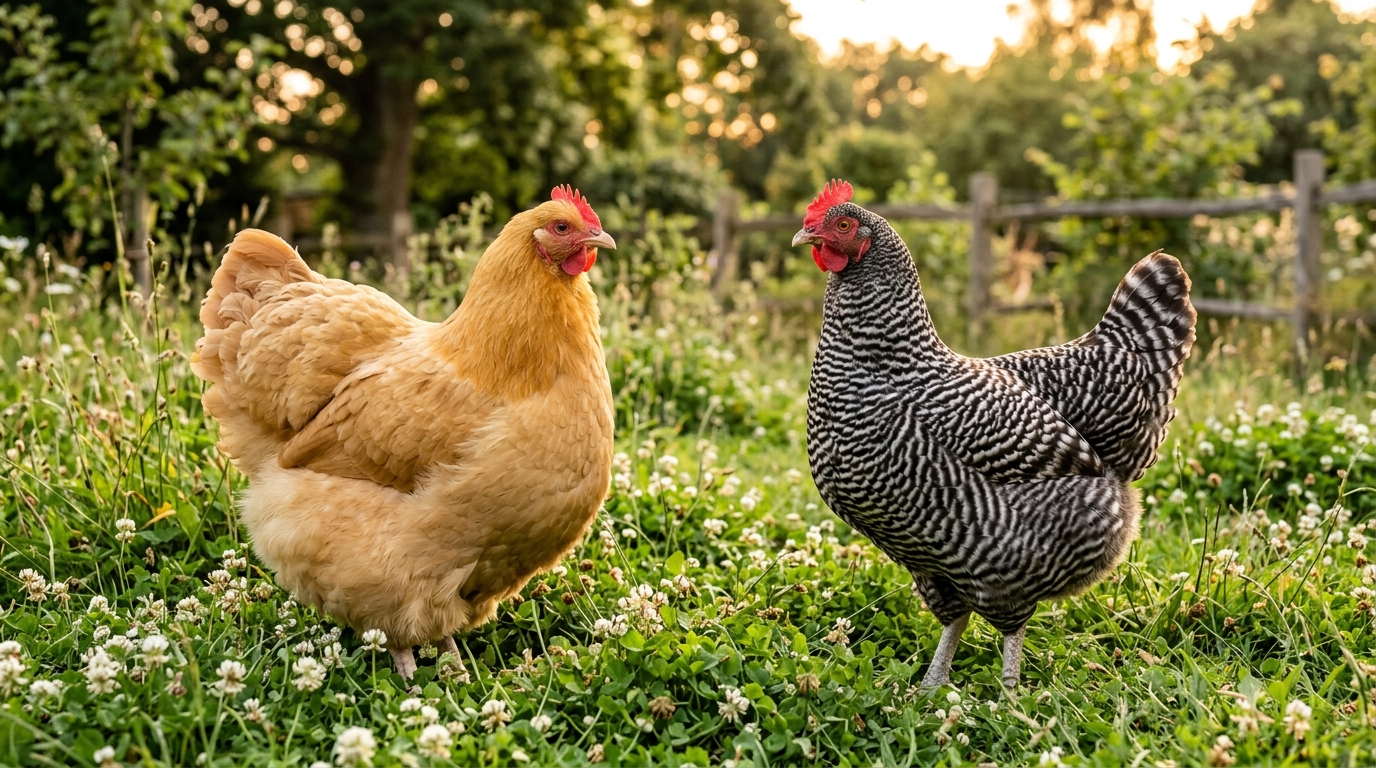
Comprehensive Comparison: Heritage Breeds vs Production Hybrids
| Evaluation Metric | Commercial Production Hybrids | Standard Heritage Breeds |
|---|---|---|
| Breeding Definition | Proprietary terminal F1/F2 crosses (Sex Links, Comets) | APA Recognized purebred lines (Rock, Sussex, Orpington) |
| Peak Egg Production | 300 to 340 eggs per year (Year 1) | 200 to 240 eggs per year (Year 1) |
| Year 3 Laying Persistence | Drops to 120 to 160 eggs (or ceases completely) | Maintains 160 to 190 eggs (75% of peak volume) |
| Reproductive Disease Rate | Over 50% incidence of peritonitis or tumors by month 30 | Under 10% incidence across 5 years of laying |
| Average Body Mass | Lightweight 4.0 to 4.5 lbs (efficient feed conversion) | Dual-purpose 6.5 to 8.5 lbs (dense muscle & bone) |
| Winter Laying Habit | Lays continuously through winter without molting pause | Undergoes standard 8 to 12-week fall molting pause |
The Pathology of Reproductive Burnout in Modern Hybrids
Modern production hybrids represent a triumph of commercial genetic engineering, but that productivity carries an inescapable physiological price:
- Continuous Follicular Ovulation: The wild red junglefowl (Gallus gallus) produces 10 to 15 eggs annually for reproduction. Heritage breeds were selectively developed to lay 200 eggs. Commercial hybrids are selected to lay nearly 365 days continuously. This relentless ovulation forces the single active left ovary and oviduct to synthesize high amounts of protein and calcium without rest.
- High Incidence of Ovarian Adenocarcinoma: Studies in avian oncology demonstrate that repetitive monthly ovulation ruptures the ovarian surface epithelium hundreds of times without a seasonal pause. By 24 to 36 months of age, over 45% of production hybrid hens develop spontaneous ovarian adenocarcinoma, which metastasizes rapidly across the peritoneal cavity.
- Egg Yolk Peritonitis & Salpingitis: As the shell gland and infundibulum fatigue from non-stop contractions, internal laying increases. Mature yolks miss the oviduct funnel and drop into the abdominal cavity, where warm body temperature breeds bacterial infections leading to fatal egg yolk peritonitis.
- Severe Osteopenia: Mobilizing 2.2 grams of calcium daily depletes structural medullary bone reserves. Hybrids frequently suffer spontaneous keel bone fractures and osteoporosis by their second winter.
The 6-Year Flock Math: Lifetime Production Economics
Evaluating chickens over a multi-year horizon reveals surprising economic realities:
- Year 1 to 2 Comparison: Two production hybrids will lay approximately 640 eggs combined in year 1, consuming roughly 175 pounds of feed. Two heritage hens will lay approximately 440 eggs, consuming 210 pounds of feed. In the short term, the hybrids produce 45% more eggs at lower feed cost.
- Year 3 to 6 Comparison: By year 3, both hybrids typically experience disease, death, or severe laying collapse (laying under 80 eggs each). The keeper must buy replacement chicks, brooder supplies, and starter feed. Meanwhile, the two heritage hens continue laying 170 eggs in year 3, 150 in year 4, and 120 in year 5.
- Cumulative Lifetime Total: Over a 6-year window, a pair of heritage hens yields over 2,200 eggs with zero flock replacement costs and minimal veterinary expenses. The hybrid path requires buying 4 to 6 replacement pullets to match the same output.
Verified Clinical References & Extension Sources
- Poultry Science: Comparative Reproductive Longevity and Ovarian Tumor Prevalence in Commercial vs Heritage Layers.
- The Livestock Conservancy: Definition of Heritage Poultry and Standard Parameters for Sustainable Production.
- Veterinary Pathology: Spontaneous Ovarian Cancer in the Domestic Hen as a Model for Avian Reproductive Pathology.