Brooder Temperature & Chick Behavior: Huddling, Panting & Heat Zones
Quick answer
Immediate Clinical Answer: Chick body language is the most accurate thermometer in the brooder. In week 1, day-old chicks require a floor hotspot temperature between 90 and 95 degrees Fahrenheit (32 to 35 degrees Celsius), reduced by 5 degrees Fahrenheit each week until fully feathered at 6 weeks. Comfortable chicks distribute evenly across the brooder floor, resting in loose groups while active chicks chirp quietly, eat, and drink. Chilled chicks cluster tightly in a dense pile directly beneath the heat source and emit loud, shrill distress chirps. Overheated chicks crowd against the outer perimeter walls with wings held away from their bodies and beaks open in panting.
| Chick Age | Target Floor Hotspot Temperature | Cool Margin Temperature | Physical Feathering Milestone |
|---|---|---|---|
| Week 1 (Day 1 to 7) | 90 to 95 deg F (32 to 35 deg C) | 70 to 75 deg F (21 to 24 deg C) | Down feathers only; unclosed navels |
| Week 2 (Day 8 to 14) | 85 to 90 deg F (29 to 32 deg C) | 68 to 72 deg F (20 to 22 deg C) | Primary wing flight feathers expanding |
| Week 3 (Day 15 to 21) | 80 to 85 deg F (27 to 29 deg C) | 65 to 70 deg F (18 to 21 deg C) | Tail feathers emerging; shoulder pinfeathers |
| Week 4 (Day 22 to 28) | 75 to 80 deg F (24 to 27 deg C) | 65 to 68 deg F (18 to 20 deg C) | Chest and back feathers developing |
| Week 5 (Day 29 to 35) | 70 to 75 deg F (21 to 24 deg C) | Ambient coop temp | Neck feathers covering down; active foraging |
| Week 6+ (Day 36+) | Weaned off heat (ambient temperature) | Ambient coop temp | Fully feathered; ready for predator-proof coop |
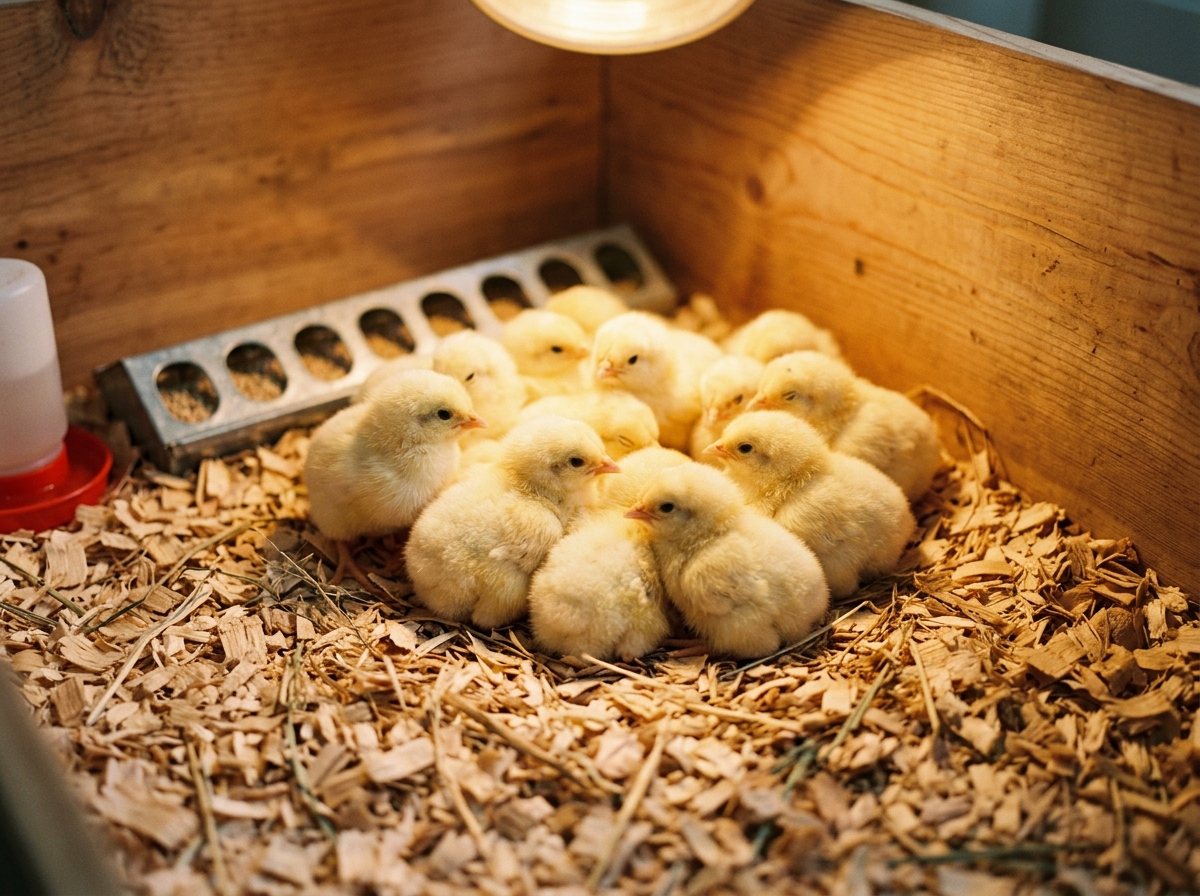
The 4 Classic Chick Behavioral Patterns
Read your flock’s spatial distribution to make instant temperature corrections:
- Comfortable Distribution (The Ideal Zone): Chicks spread evenly throughout the brooder. Some sleep comfortably beneath the heat source, while others explore, eat at feeders, and drink. Chirping is soft, musical, and low in volume. No action required.
- Severe Chilling (The Pyramiding Hazard): Chicks cluster into a tight, dense pyramid directly beneath the heat source, crying with high-pitched, persistent distress chirps. Chicks at the bottom of the pile risk suffocation within 30 minutes. Action: Lower the heat plate, increase bulb wattage, or eliminate drafts.
- Severe Overheating (The Perimeter Ring): Chicks flee the center of the brooder, crowding against the outer walls or corners. Wings are held outward like mini capes, necks are stretched, and beaks are wide open in panting. Feeders in the center are abandoned. Action: Raise the heat lamp immediately or adjust heat plate legs.
- Draft Exposure (The One-Sided Bunch): Chicks crowd against one side of the brooder while avoiding the opposite side completely. This indicates a cold air current blowing from a window, exterior door, or ventilation seam. Action: Install solid cardboard brooder draft shields 18 inches high around the brooder perimeter.
Confirm whole-brooder comfort and evaluate early growth metrics using the Interactive Chicken Symptom Checker.
Radiant Heat Plates vs Traditional Infrared Lamps
| Evaluation Metric | Radiant Heat Plate (e.g. Brinsea / Sweeter Heater) | 250W Red Glass Heat Lamp |
|---|---|---|
| Barn Fire Hazard | Zero: Operates at safe 115 to 125 deg F surface warmth | Extremely High: 500 deg F surface ignites dry pine shavings |
| Natural Circadian Rhythm | Dark underside mimics mother hen; chicks sleep in dark | Constant 24/7 glare disrupts sleep cycles and causes pecking |
| Electrical Power Consumption | 15 to 45 Watts (very economical) | 250 Watts continuous draw (high electric bill) |
| Chilling Redundancy | Solid-state heating element lasts years without burnout | Single bulb burnout overnight causes 100% chick loss |
Practical Setup Rules for Brooder Climate Control
Follow these 4 engineering standards to ensure a safe thermal gradient:
- Establish a Thermal Gradient: Never heat the entire brooder to 95 degrees Fahrenheit. Chicks require a warm basking zone (90 to 95 degrees Fahrenheit) to warm up and a cooler foraging zone (70 to 75 degrees Fahrenheit) to feed and exercise. A thermal gradient stimulates natural thermoregulation and prevents lethargic overheating.
- Calibrate Radiant Plate Height: Adjust the legs of a radiant heating plate so one end is set at chick shoulder height (approximately 2.5 to 3 inches off the bedding) while the opposite end is set 1 inch higher. This slanted orientation allows smaller chicks to find closer contact while larger chicks use the higher end.
- Eliminate Wall Corners with Brooder Guards: Round the corners of rectangular boxes with flexible cardboard brooder guards. If chicks panic or chill, square 90-degree corners create death traps where chicks pile and crush one another.
- Daily Thermometer Verification: Place a digital thermometer with a probe at floor level directly beneath the heat source. Do not rely on ambient wall thermometers, as floor-level temperatures on wood or concrete can be 10 degrees colder than air 12 inches higher.
When to Involve an Avian Veterinarian
Contact a veterinarian if you encounter:
- Chicks that continue open-mouth panting or shaking violently after brooder temperatures have been verified between 90 and 95 degrees Fahrenheit.
- Sudden mass mortality following a brief overheating incident, indicating acute heat-induced pulmonary edema.
- Chicks developing persistent swollen joints, curled toes, or crooked beaks despite balanced temperatures and quality starter rations.
Verified Clinical References & Extension Sources
- University of Missouri Extension: Brooding and Rearing Backyard Flocks: Temperature Management.
- Merck Veterinary Manual: Brooding Environment and Behavioral Responses in Poultry.
- Cornell University Cooperative Extension: Care and Management of Baby Chicks: Heat and Housing.
- University of Kentucky Extension: Small Flock Brooding: Heat Sources and Safety Standards.