
How Long Do Chicks Need a Heat Lamp? Week-by-Week Guide
Quick answer
Chicks often need supplemental heat for roughly 4-6 weeks, starting near 95°F in week one and tapering about 5°F weekly. Confirm with behaviour and a chick-height thermometer, not the calendar alone.
Quick facts
| Typical duration | Often about 4-6 weeks, adjusted by behaviour and weather, not a calendar-only rule |
|---|---|
| Week-one target | Commonly near 95°F (35°C) at chick height, then about 5°F lower each week |
| Behaviour check | Huddling under heat = too cold; panting / edge-avoidance = too hot; evenly spread = closer to right |
| Safer alternative | Many keepers prefer brooder plates / heating plates to reduce fire risk vs open bulbs |
| Cool zone | Chicks need a warm side and a cooler escape side so they can self-regulate |
| Graduation | See when chicks can go outside for outdoor timing |
| Adult cold nights | Hardy adults are different; see cold nights |
| Tool | Use the brooder temperature guide for week targets |
How long do chicks need a heat lamp? Long enough to stay warm while feathers grow, commonly several weeks, and not longer than behaviour and temperatures justify. Use chick behaviour and a thermometer at chick height, not a rigid calendar alone.
This guide covers the common week-by-week temperature ladder, how to read comfort signals, lamp vs plate tradeoffs, fire-safe setup, weaning steps, and how heat duration connects to outdoor graduation. Pair it with the interactive chicken brooder temperature tool when you want a quick week target.
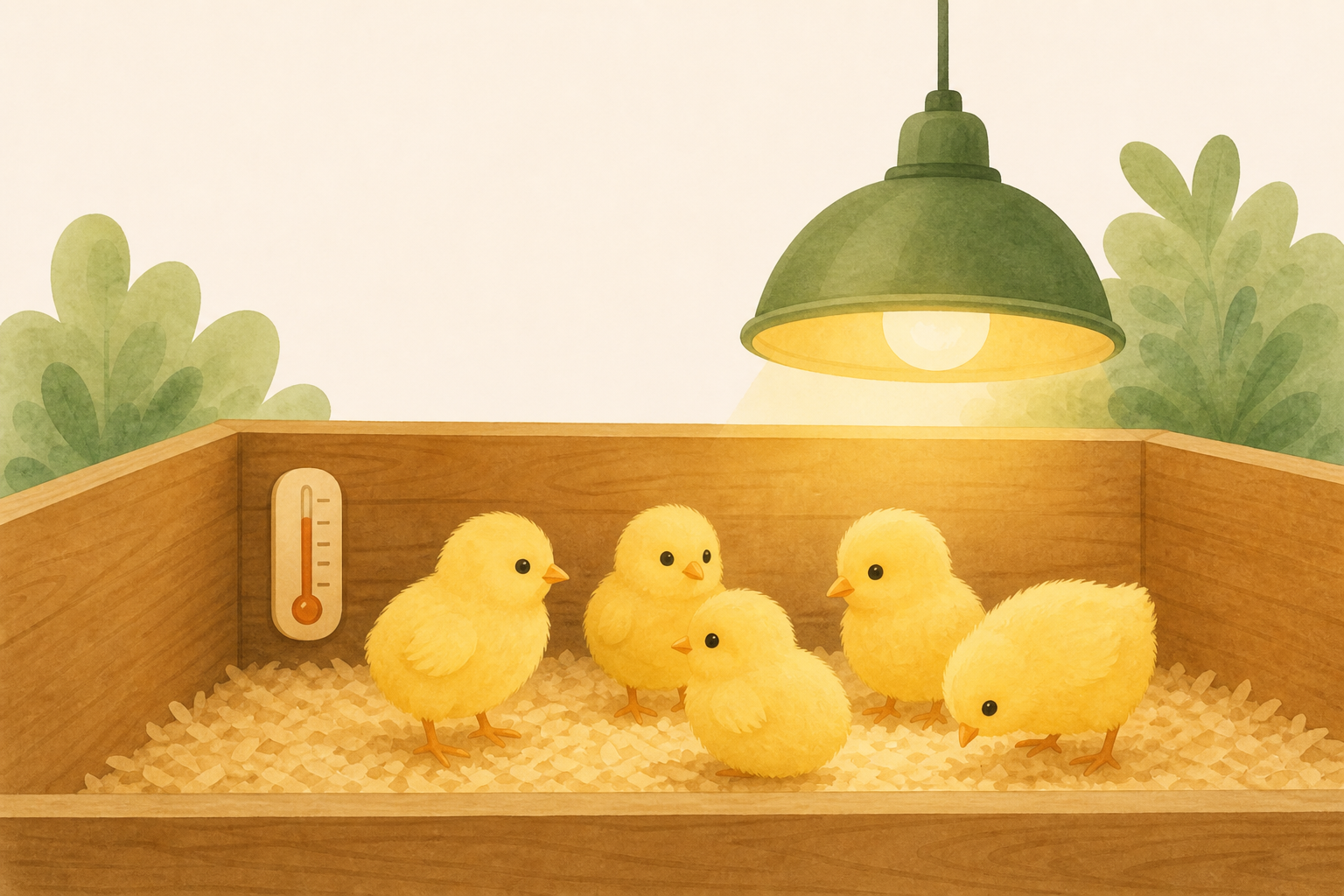
Week-by-week heat pattern (starting point)
A widely used extension-aligned pattern starts near 95°F in week one and drops about 5°F weekly. Confirm live targets with the chicken brooder temperature tool, then override with what you see.
- Week 1: about 95°F at chick height
- Week 2: about 90°F
- Week 3: about 85°F
- Week 4: about 80°F
- Week 5-6+: continue tapering toward room or coop temperatures if chicks are feathered and behaviour stays calm
Room temperature, drafts, overcrowding, and damp litter change how long each step lasts. A chilly garage may keep chicks on heat longer than a warm laundry room even when the calendar looks identical.
Why behaviour beats the calendar
Chicks vote with their feet. A perfect thermometer reading still fails if the probe sits on a warm wall while chicks sleep in a cold corner.
- Huddling in a tight pile under heat usually means too cold or a draft.
- Panting, wings out, pressed to the far edge usually means too hot.
- Even spacing with soft peeping is the comfort signal many keepers watch for.
- Loud, frantic peeping after a temperature change is a cue to re-check placement and drafts.
- Cold rooms, damp air, and overcrowding change how long supplemental heat is needed.
Check at chick height, not at adult eye level. Recheck after you add bedding, move the lamp, or open a window. Overnight is when mistakes show up: a setup that looked fine at noon can chill chicks by morning.
Heat lamp vs brooder plate
Open heat lamps work when fixtures are secure, clearance is honest, and litter never contacts the bulb. They are also a leading backyard fire hazard when clamps tip, cords stretch, or bedding piles up under a hot surface.
Brooder plates (heating plates) provide radiant heat chicks can duck under, often with lower open-flame-style fire risk when used as directed. Plates still need correct height, dry litter, and enough floor space so chicks are not forced into a packed hot zone.
Either way, choose listed fixtures, keep cords out of pecking range, and keep a working thermometer. “Warm enough” is useless if the brooder burns.
Brooder setup basics that change duration
- Gradient: warm area plus a cooler escape zone.
- Draft control: block floor-level wind without sealing the brooder into a damp box.
- Dry litter: wet bedding chills chicks even when air reads warm.
- Space: overcrowding creates hot and cold pockets and stress pecking.
- Feed and water: place so chicks can eat without camping under the hottest point all day.
If you later move birds outdoors, predator-proof housing matters as much as heat weaning. Use hardware cloth on openings, not chicken wire alone, and plan ventilation with the coop ventilation guide.
Weaning off heat
- Raise the lamp or plate, or lower wattage/settings, in small steps.
- Keep a cool zone so chicks can self-regulate during the wean.
- Watch overnight behaviour after each change for at least one full night.
- Do not remove heat and move fully outdoors on the same stressful day.
- Delay unsupervised outdoor living until feathering and housing support it; see when can chicks go outside.
Cold snaps after a warm week are classic setbacks. If ambient nights drop hard, pause the wean even if the calendar says “done.” Adult winter questions are a different topic: hardy feathered birds in dry housing often need draft and moisture control more than heat lamps; see what temperature is too cold for chickens at night.
Decision guidance
- Under 3-4 weeks, poorly feathered: keep a reliable heat gradient.
- Fully feathered and calm in room temps: begin weaning; watch nights.
- Cold house or cold snap: slow the wean even if the calendar says done.
- Fire-anxious setup: prefer a plate-style heater used as directed.
- Ready for outdoors: only after heat weaning and a secure coop plan align.
Common mistakes
- Watching the thermometer only and ignoring chick behaviour.
- Leaving heat on too long after chicks are feathered and weaned.
- Uneven heat with no cool zone to escape.
- Fire hazards: tippy lamps, low clearance, bedding contact.
- Applying adult coop rules to downy chicks.
- Rushing outdoor transition before feathers and weather match.
FAQ
How long do chicks need a heat lamp?
Often roughly 4-6 weeks, adjusted by feathering, behaviour, and ambient temperature.
Do I have to start at 95°F?
It is a common starting target for week one at chick height. Verify with behaviour.
Are brooder plates better than lamps?
Many keepers prefer plates for fire-risk reasons. Both require correct setup.
When can they go outside?
See when can chicks go outside. Heat weaning and outdoor graduation are related but not identical.
Can I leave a heat lamp on for adult chickens in winter?
Often unnecessary for hardy adults in dry, draft-free housing, and lamps add fire risk. Fix housing first.
What if chicks huddle only at night?
Nighttime is colder. Recheck chick-height temperature after dark and slow the wean.
Sources and further reading
- Ohio State University Extension (Ohioline): Raising Meat Chickens (brooding temperature table)
- NC State Extension: Keeping Garden Chickens in North Carolina
- eXtension poultry resource hub (poultry.extension.org)
- Flockline Learn related guides linked in this article.
- Community patterns synthesized from public backyard-poultry discussions; individual forum URLs are not cited because they rot and anecdotes vary.