Hawk Netting vs Hardware Cloth Roof: Complete Run Security Guide
Quick answer
Hawk netting stops daytime aerial raptors like hawks and owls affordably, but only 1/2-inch welded hardware cloth provides total protection against climbing predators, raccoons, and heavy winter snow loads.
Quick Facts: Overhead Chicken Run Security
| Primary Aerial Threats | Red-tailed hawks, Cooper’s hawks, and great horned owls |
|---|---|
| Hawk Netting Material | Heavy knotted ultraviolet-resistant polyethylene (1-inch to 2-inch mesh) |
| Hardware Cloth Spec | 19-gauge hot-dipped galvanized steel with 1/2-inch square grid |
| Snow Load Capacity | Netting sags under wet snow; hardware cloth requires sloped structural framing |
| Climbing Predator Defense | Netting fails against raccoons and weasels; hardware cloth blocks 100% of climbs |
| Cost Comparison | Netting costs $0.15 to $0.35 per sq ft; hardware cloth costs $1.20 to $2.00 per sq ft |
Hawk Netting vs Hardware Cloth: Structural Security Breakdown
Backyard chicken keepers lose birds to daytime hawk strikes and nocturnal owl raids. Choosing between flexible flight netting and rigid welded wire depends on flock run footprint, regional winter weather, and local ground predator pressure. Review this direct comparison:
| Security Factor | UV Knotted Hawk Netting | 1/2-Inch Welded Hardware Cloth |
|---|---|---|
| Aerial Raptor Defense | Excellent against daytime diving hawks and swooping owls | Impenetrable physical armor against all avian predators |
| Climbing Mammal Security | Zero protection. Raccoons, opossums, and weasels rip or chew through | Complete exclusion of raccoons, mink, rats, and snakes |
| Snow & Ice Load Behavior | Accumulates slush, sags rapidly, and snaps frame posts under weight | Sheds snow when installed on 4:12 pitch rafters with central support |
| Installation Complexity | Quick string-and-carabiner setup across perimeter posts and center poles | Demands heavy timber roof framing, purlins, screws, and fender washers |
| Square Foot Cost | Budget friendly ($0.15 to $0.35 per square foot) | Substantial upfront investment ($1.20 to $2.00 per square foot) |
Raptor Strike Mechanics: How Hawks Attack Chicken Runs
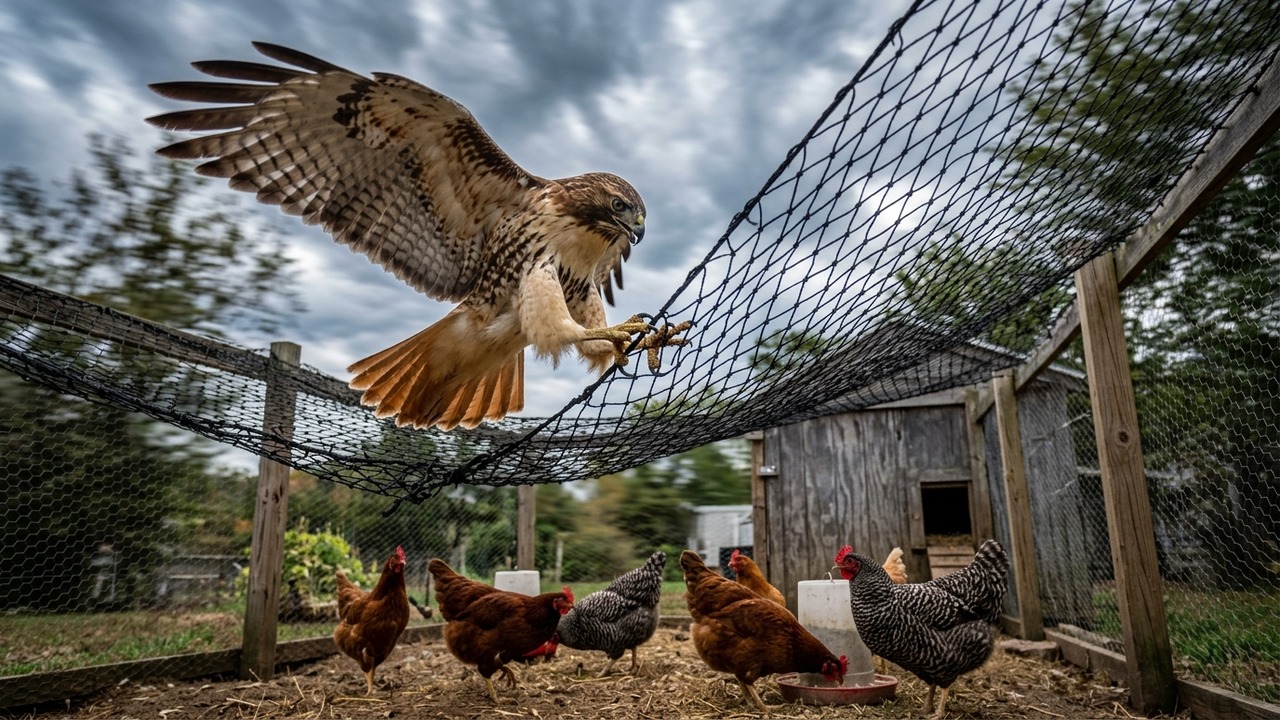
Hawks are opportunistic ambush hunters. Cooper’s hawks use agility to weave through tree branches and strike young pullets, while larger red-tailed hawks perch on nearby telephone poles or fence posts before launching a steep dive. Understand how raptor attacks unfold:
- Kinetic Impact Dives: Red-tailed hawks strike from steep dives at speeds exceeding 120 mph, aiming to stun prey with blunt talons upon impact. Knotted polyethylene netting flexes on impact, absorbing momentum and bouncing the raptor back without tearing or puncturing.
- Perimeter Reach-Through Maneuvers: Goshawks and Cooper hawks will land directly on fence rails or run roofs, reaching extended talons through loose openings to grab roosting hens. Netting mesh must be 2 inches or smaller, or reinforced with 1/2-inch hardware cloth along low eaves.
- Nocturnal Silent Raids: Great horned owls hunt silently at dusk and night, perching on run roof beams and dropping straight down. Rigid hardware cloth roofs block heavy 4-pound owls completely, while netting requires central support posts to prevent sagging under predator weight.
- Tension and Anchor Integrity: Overhead flight netting must be battened down every 12 inches along structural purlins. Loose, billowing netting creates entry pockets where diving raptors can wedge underneath or become fatally entangled.
Winter Snow Load Defense: Preventing Roof Collapses
Winter storms destroy hundreds of poultry runs every year. Wet snow clings to nylon strands, transforming lightweight netting into an immense frozen sheet weighing hundreds of pounds. When support poles buckle, the collapsing mesh pins flock members to the frozen ground, leaving them vulnerable to wandering predators.
Frequently Asked Questions
Can a hawk break through chicken wire on top of a run?
Hawks rarely tear through metal chicken wire, but standard hexagonal wire allows climbing raccoons to rip entry holes at night. Also, heavy snow tears chicken wire staples out of top plates easily.
What mesh size is best for chicken run hawk netting?
Select knotted polyethylene netting with a 1-inch to 1.5-inch mesh size. Mesh openings larger than 2 inches allow smaller songbirds and juvenile Cooper’s hawks to squeeze through, while smaller 1/2-inch netting traps too much heavy winter snow.
Do shiny hanging CDs or scare tape deter hawks permanently?
Visual scare tactics like reflective tape, shiny discs, and plastic owl decoys provide temporary relief for only 3 to 7 days. Hungry hawks quickly realize the objects pose no real danger and resume hunting.
How high should a covered chicken run roof be?
Build your run roof at least 6 feet high. A walk-in ceiling allows you to clean bedding, refill heavy waterers, and inspect fence lines comfortably without hunching or bumping your head.
Evidence & Research Citations
- Penn State Extension: Poultry Predator Management and Coop Security Design
- University of Georgia Extension: Constructing Predator-Proof Backyard Poultry Housing
- Cornell Cooperative Extension: Identifying Common Avian Predators of Small Livestock