Chicken Heat Exhaustion Emergency: Tepid Water Bath Protocol, Core Cooling & Triage Signs
Quick answer
Immediate Emergency Protocol: Avian heat exhaustion is an acute medical emergency that occurs when a chicken's internal core body temperature exceeds 108.5 to 110.0 degrees Fahrenheit (42.5 to 43.3 degrees Celsius), climbing past normal avian body temperature of 105.0 to 107.0 degrees Fahrenheit (40.5 to 41.7 degrees Celsius). When body temperature surpasses 112 degrees Fahrenheit (44.4 degrees Celsius), cellular protein denaturation and irreversible organ failure begin. Clinical symptoms include wings splayed wide away from the body, rapid continuous gular fluttering (open-beak panting), pale or dusky purple comb and wattles, half-closed unresponsive eyes, and lateral recumbency (inability to stand). First aid action: immediately submerge the bird up to her neck in a tub of tepid or lukewarm water (75 to 85 degrees Fahrenheit / 24 to 29 degrees Celsius) for 5 to 8 minutes while gently massaging water into breast and belly feathers. CRITICAL WARNING: Never submerge an overheating chicken in ice water or water under 65 degrees Fahrenheit (18.3 degrees Celsius). Extreme cold causes rapid peripheral vasoconstriction in leg and skin capillaries, shunting scalding blood into internal organs, trapping core heat, and triggering fatal cardiac arrest.
Quick facts
| Normal Core Temperature | 105.0 to 107.0 degrees Fahrenheit (40.5 to 41.7 degrees Celsius) |
|---|---|
| Heat Exhaustion Threshold | 108.5 to 110.0 degrees Fahrenheit (42.5 to 43.3 degrees Celsius) |
| Fatal Cellular Lysis Point | 112.0 degrees Fahrenheit (44.4 degrees Celsius) causing multi-organ failure |
| Correct Water Temperature | 75 to 85 degrees Fahrenheit (24 to 29 degrees Celsius) tepid/lukewarm water |
| Ice Water Danger | Triggers acute capillary vasoconstriction, core heat trapping, and heart attack |
| Emergency Soak Duration | 5 to 8 minutes submerged from the shoulders down, keeping the head completely dry |
Acute avian heat exhaustion and heat stroke represent life-threatening medical emergencies in backyard poultry. Because chickens are heavily insulated with down feathers and lack perspiration capabilities, their core thermal mass increases rapidly in stagnant air exceeding 95 degrees Fahrenheit (35.0 degrees Celsius). Understanding the difference between mild heat discomfort and clinical heat stroke dictates whether a bird survives the afternoon.
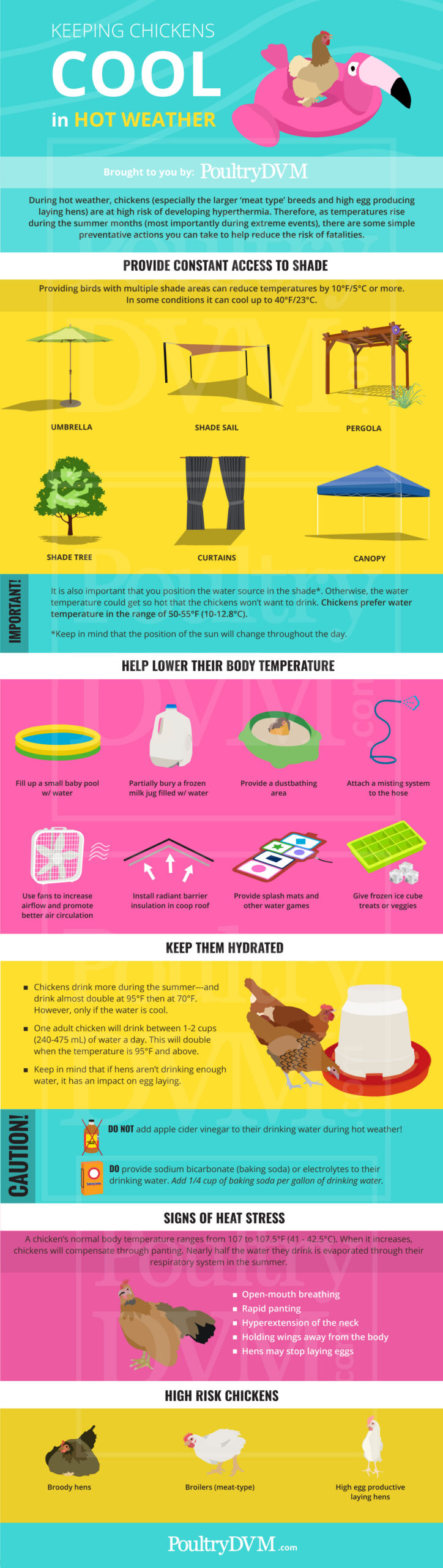
Clinical Triage Matrix: Mild Heat Stress vs Acute Heat Stroke
| Clinical Stage | Observable Behaviors | Core Body Temp | Urgency & Required Action |
|---|---|---|---|
| Stage 1: Normal Coping | Resting in shade, wings slightly lifted, drinking 2x normal water | 105.0 to 107.0 F | Low: Ensure abundant shade, ventilation, and fresh cool water |
| Stage 2: Mild Heat Stress | Active gular fluttering (panting), wings held 2 inches from body, reduced feed intake | 107.0 to 108.5 F | Medium: Add fans, provide electrolytes, mist shaded perimeter |
| Stage 3: Heat Exhaustion | Heavy continuous open-beak panting, wings dragging on ground, pale/cyanotic comb | 108.5 to 110.0 F | High: Move immediately to cool indoor room; initiate water bath |
| Stage 4: Moribund Heat Stroke | Unable to stand (recumbent), glassy non-blinking eyes, seizures, limp neck | Above 110.5 F | Critical: Emergency tepid soak; administer subcutaneous fluids |
The 5-Step Emergency Tepid Water Bath Protocol
When a chicken enters Stage 3 or Stage 4 heat prostration, evaporative air cooling is too slow. Conductive water cooling is required. Execute this veterinary protocol immediately:
- Prepare Tepid Water (75 to 85°F): Fill a shallow utility tub, 5-gallon bucket, or laundry sink with 4 to 6 inches (10 to 15 cm) of tepid water. Verify the temperature with an aquarium or meat thermometer. Water should feel neutral or slightly cool to human skin, never chilled or freezing.
- Shoulder-Deep Submersion: Supporting the chicken’s keel bone and abdomen with two hands, lower her body into the water up to the base of her neck. Keep the head, beak, nostrils, and eyes completely dry and elevated at all times. Inhaling water into air sacs causes rapid drowning.
- Part Feathers for Skin Contact: Gently use your fingers to separate dense breast, wing pit, and vent feathers. Air pockets trapped between feathers act as insulation; parting feathers allows tepid water to contact the highly vascularized skin of the brood patch and thighs directly.
- Cool the Comb and Wattles: While the body is submerged, use your fingers to splash tepid water gently onto the comb and wattles. These fleshy appendages contain extensive arteriovenous capillary networks that dissipate heat rapidly.
- Duration & Slow Towel Dry: Maintain submersion for 5 to 8 minutes maximum. Remove the bird when her panting slows and her eyes become responsive. Wrap her loosely in a dry towel to absorb dripping water; do not blow dry with heat.
Post-Cooling Recovery and Shock Management
Once removed from the bath, the bird remains metabolically fragile for 24 to 48 hours:
- Isolate in an Air-Conditioned Recovery Area: Place the chicken in a dog crate lined with clean dry towels in an air-conditioned garage, basement, or bathroom held at 72 to 76 degrees Fahrenheit (22 to 24 degrees Celsius). Provide a quiet, dim environment to lower acute heart rates (which can exceed 400 bpm during heat crisis).
- Oral Rehydration Without Forcing: Offer cool water with balanced electrolytes in a small, deep bowl. Never use a syringe to force liquid down an exhausted bird’s throat, as the glottis at the base of the tongue remains open during heavy breathing, causing fatal lung aspiration. Dip her beak tip gently into the water once she can sit upright.
- Re-Introduce at Dusk: Keep the bird indoors until evening temperatures drop below 80 degrees Fahrenheit (26.7 degrees Celsius). Re-integrate her onto the roost bar under cover of darkness after verifying normal standing posture and firm droppings.
Verified Clinical References & Extension Sources
- Veterinary Clinics of North America: Exotic Animal Practice: Emergency Triage and Fluid Therapy for Avian Heat Prostration.
- Penn State Extension: Recognizing and Treating Heat Stress Emergencies in Backyard Chickens.
- University of California Davis Veterinary Medicine: Hyperthermia Pathology and First Aid Cooling Protocols in Galliformes.