Poultry Electrolytes for Heat Stress: Water Dosing Math, Alkalosis Science & Osmotic Limits
Quick answer
Immediate Nutritional Answer: During severe summer heat exceeding 88 degrees Fahrenheit (31.1 degrees Celsius), chickens cool themselves by hyperventilating (panting), accelerating from 25 breaths per minute up to 150 to 250 breaths per minute. This rapid respiratory rate expels excessive carbon dioxide (CO2), causing blood carbonic acid to plunge and blood pH to surge above 7.50, a life-threatening physiological condition called respiratory alkalosis. To buffer this alkaline shift, avian kidneys flush essential potassium (K+), sodium (Na+), and bicarbonate (HCO3-) ions into droppings, draining cellular electrolytes and causing thin-shelled eggs. Homemade emergency electrolytes require exact measurement per 1 gallon (3.785 liters) of cool water: 1/2 teaspoon (2.5 grams) non-iodized salt, 1/2 teaspoon (2.5 grams) potassium chloride (Nu-Salt salt substitute), 1 teaspoon (5.0 grams) sodium bicarbonate (baking soda), and 1 tablespoon (12.5 grams) sugar or dextrose. Never administer electrolytes for more than 3 consecutive days, and always offer a second container of plain clean water to prevent osmotic kidney overload and severe diarrhea.
Quick facts
| Respiratory Panting Rate | Increases from 25 breaths/min to 150 to 250 breaths/min during heat stress |
|---|---|
| Clinical Condition | Respiratory alkalosis (blood pH shifts from normal 7.28 to abnormal >7.50) |
| Critical Lost Buffers | Bicarbonate (HCO3-), potassium (K+), sodium (Na+), and ionic calcium (Ca2+) |
| Standard Gallon Dosing | 1 tsp baking soda + 1/2 tsp salt + 1/2 tsp potassium chloride + 1 tbsp sugar |
| Consecutive Use Limit | Maximum 3 to 4 days consecutively to avoid severe mineral osmotic diarrhea |
| Mandatory Water Rule | Always provide a second waterer filled exclusively with unmedicated clean water |
Poultry electrolyte supplementation during hot summer weather is grounded in avian renal physiology and acid-base blood chemistry. When chickens pant to dissipate heat, they disrupt the delicate carbonate buffering system that sustains cardiovascular function, cellular hydration, and eggshell calcification. Administering properly balanced electrolytes restores systemic equilibrium, while improper overdosing induces debilitating intestinal dehydration.
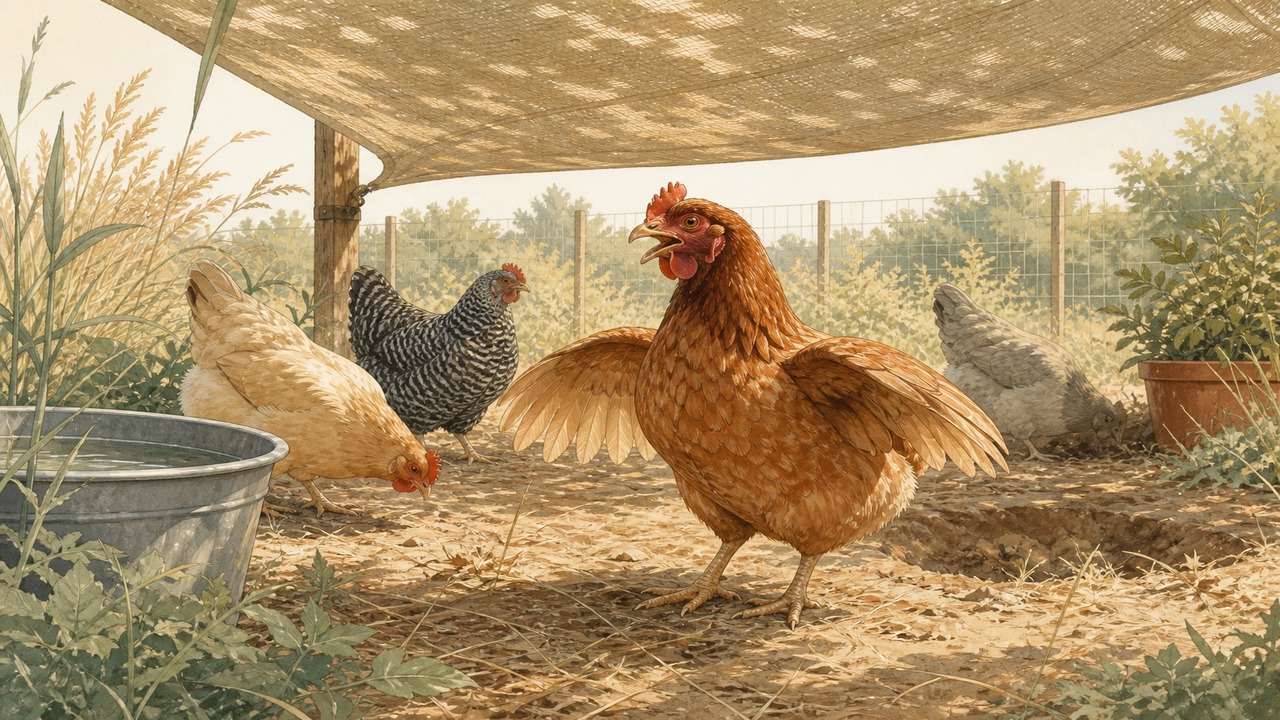
The Physiology of Respiratory Alkalosis in Laying Hens
Unlike mammals that dissipate heat through dermal perspiration, birds possess non-glandular skin insulated by thousands of contour feathers. Cooling occurs almost entirely across the mucosal surfaces of the oral cavity and upper respiratory tract. This cooling process triggers a cascade of biochemical disturbances:
- Hyperventilation & Carbonic Acid Depletion: As ambient heat exceeds 85 degrees Fahrenheit (29.4 degrees Celsius), respiratory gular fluttering accelerates tenfold. The bird expels carbon dioxide (CO2) faster than metabolic tissues produce it. This rapid loss depletes carbonic acid (H2CO3) in systemic circulation.
- Alkaline Blood Shift: Normal avian venous blood pH ranges from 7.25 to 7.32. Sustained panting drives blood pH upward to 7.50 to 7.65. In an alkaline environment, plasma proteins bind ionic calcium, reducing free ionized calcium available for eggshell formation. Consequently, summer eggs frequently display soft, corrugated, or ultra-thin shells.
- Renal Buffer Dumping: In an attempt to lower blood pH, the kidneys dump basic bicarbonate ions (HCO3-) into the ureters. Because bicarbonate excretion is biochemically paired with potassium and sodium cations, the bird rapidly suffers cellular dehydration and muscular weakness.
Clinical Formulation: Homemade vs Commercial Electrolyte Blends
| Active Component | Homemade Recipe (Per Gallon) | Commercial Formulation (e.g., Sav-A-Chick) | Biological Purpose |
|---|---|---|---|
| Sodium Bicarbonate | 1 level teaspoon (5.0 g) | Sodium bicarbonate carrier | Directly replenishes lost blood HCO3- buffers |
| Potassium Chloride | 1/2 level teaspoon (2.5 g) | Potassium chloride 0.15% | Maintains intracellular volume & heart rhythm |
| Sodium Chloride | 1/2 level teaspoon (2.5 g) | Sodium chloride 0.30% | Restores extracellular osmotic water balance |
| Dextrose / Sugar | 1 level tablespoon (12.5 g) | Dextrose carrier | Accelerates sodium-glucose intestinal transport |
| Vitamin Supplement | None (add 100 mg Vitamin C) | Vitamin A, D3, E, and B-complex | Supports antioxidant and cellular integrity |
The 4 Golden Rules of Summer Electrolyte Administration
To support flock health without inducing secondary metabolic complications, adhere to these 4 veterinary guidelines:
- Rule 1: Always Provide a Plain Water Control: Place a standard 3-gallon font of pure, cool well water (50 to 65 degrees Fahrenheit) alongside the electrolyte water. Chickens possess sensitive osmoreceptors in their palate and will alternate between plain and mineral water according to biological need.
- Rule 2: Observe the 72-Hour Duration Limit: Administer electrolytes for a maximum of 3 consecutive days during the peak of a heat wave. Prolonged exposure forces excess minerals through the renal tubules, creating osmotic diarrhea, dehydration, and wet coop litter.
- Rule 3: Replace Water Daily: Sugar and minerals in warm summer weather accelerate bacterial proliferation. Dump, rinse, and refill electrolyte fonts every 24 hours. Never allow solutions to sit in direct sun.
- Rule 4: Never Add Apple Cider Vinegar During Heat Waves: While apple cider vinegar is popular in winter, it acts as an acidifier that interferes with bicarbonate absorption during heat-induced respiratory alkalosis. Reserve vinegar strictly for cool seasons.
Verified Clinical References & Extension Sources
- Mississippi State University Extension: Managing Respiratory Alkalosis and Electrolyte Balance in Heat-Stressed Poultry.
- University of Florida Animal Science: Nutritional and Water Strategies to Alleviate Heat Stress in Laying Hens.
- Merck Veterinary Manual: Acid-Base Disturbances and Renal Physiology in Domestic Birds.