
Chicken Tail Down: Egg Binding Signs & What to Do
Quick answer
Observing a chicken tail down lethargic droopy wings usually indicates severe abdominal pain, commonly from egg binding or reproductive infection. The hen will often stand like a penguin and strain without producing an egg. Move the bird to a quiet, warm, and dimly lit isolation crate to reduce stress. Offer fresh water with poultry electrolytes. You can provide a warm Epsom salt bath to help relax the vent muscles, but avoid physically pulling on any stuck eggs. Do not massage the abdomen, as this can rupture internal tissues. If the hen cannot pass the egg or begins open-mouth breathing, seek avian veterinary care immediately.
Quick facts
| Normal Posture | Tail held high (+45°), alert stance, active foraging |
|---|---|
| Tucked Tail (-30°) | Indicates abdominal pain, egg binding, or severe weakness |
| Penguin Stance | Upright stance with drooped tail; key indicator of egg binding or ascites |
Chicken Tail Down Posture & Abdominal Health Guide
Abdominal pain indicators, cloacal palpation protocols, egg binding triage, and vent gleet differentiation.
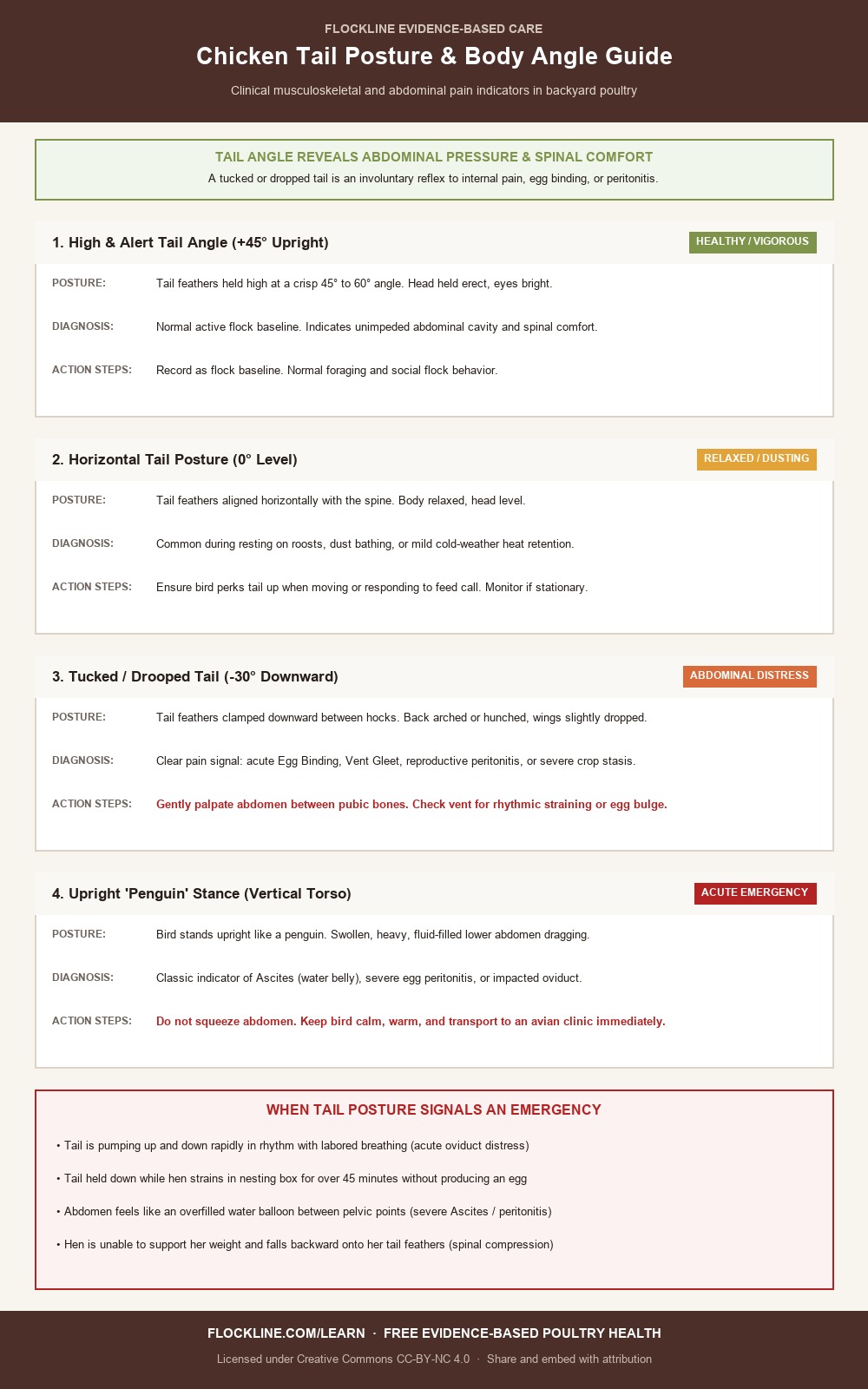
Watch the whole bird, not just the tail
Stand far enough away that the bird returns to normal behaviour. Look from the side and record whether the tail stays low while walking, feeding, and resting. Then check whether the back is level or hunched, the wings are held normally, and the bird can keep up with the flock.
Breathing changes the urgency. Visible effort, open-mouth breathing, or pronounced tail movement with each breath is different from a tail that is simply carried lower than usual.
Flockline whole-bird posture frame
Tail
- Record
- Usual, slightly lower, or held down continuously
- Compare
- At rest and while walking
Stance
- Record
- Standing evenly, crouched, unstable, or unable to stand
- Compare
- Head, back, wings, and response to movement
Context
- Breathing
- Quiet versus effortful or noisy
- Intake
- Observed eating and drinking, not assumed
- Other changes
- Comb, eyes, droppings, laying, or flock pattern
Record before handling
A short video from the side can preserve movement and breathing clues for a veterinarian. Do not force the bird to walk for the camera. Note when the posture started and whether it is constant or intermittent.
When a lowered tail is urgent
Seek urgent veterinary help if the bird collapses or cannot stand, has extreme difficulty breathing, uncontrolled bleeding, seizures or other marked neurologic signs, or is worsening quickly. Sudden illness or death in several birds, especially with respiratory, neurologic, swelling, or diarrhea signs, also needs prompt professional and local animal-health guidance.
What owners usually notice next
Choose the observation that most closely matches what you can see now. If urgent signs are present, contact a veterinarian rather than continuing through the guides.
- She is also quiet or not eatingReturn to the whole-bird triage sequence.
- The comb also looks paleCompare colour in even light and note weakness or breathing changes.
- Droppings have also changedRecord whether the change is repeated and paired with behaviour changes.
- The posture does not fitUse the checker to choose the next visible observation.
FAQ
Does tail down mean a chicken is egg bound?
No. Tail position alone cannot confirm egg binding or any other condition.
Should I feel the abdomen?
Avoid forceful palpation. Record visible signs and ask a poultry-experienced veterinarian what examination is appropriate.
Is one photo enough?
A side photo helps, but a short video and timeline usually preserve posture and movement more clearly.
Sources and references
- Merck Veterinary Manual: Physical Examination & Abdominal Palpation Guidelines.
- University of Georgia Extension: Backyard Poultry Health Management (Publication C1091).