Weasel & Stoat Entry Proofing: 1/4-Inch Hardware Cloth & Coop Skull Defense
Quick answer
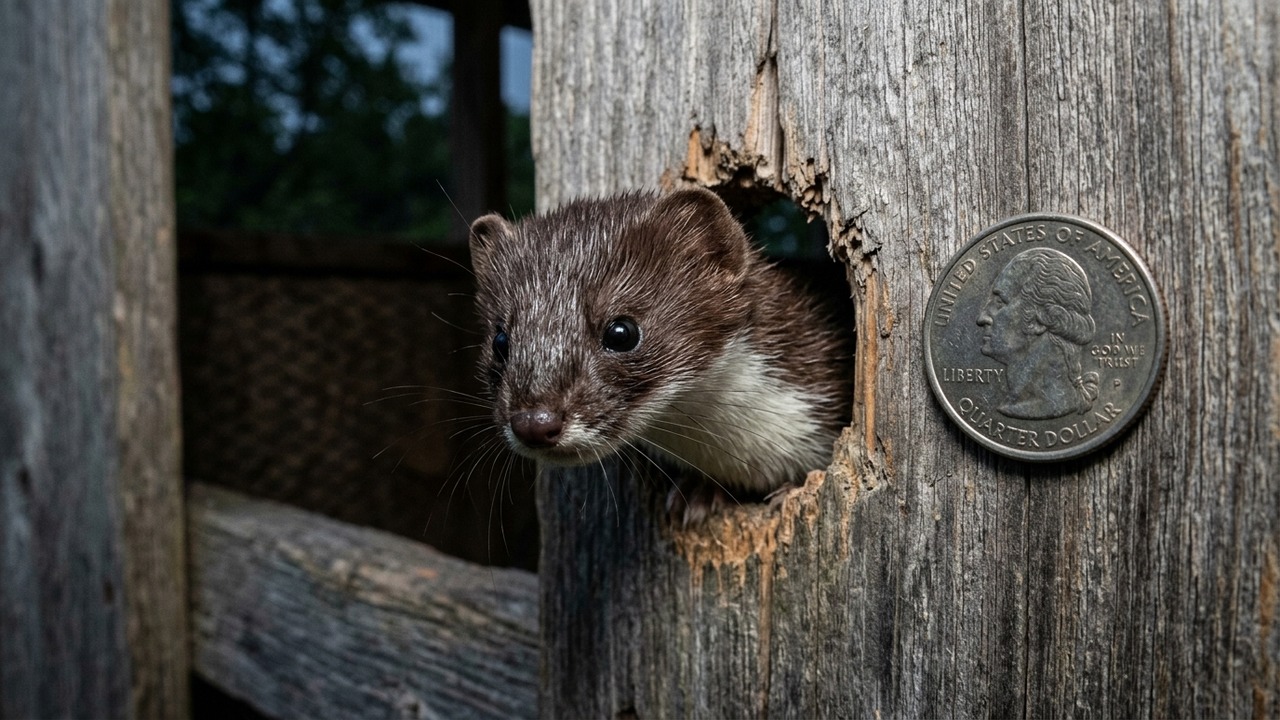
Immediate Clinical Answer: Weasels and stoats enter chicken coops through openings as small as 0.85 inches (21 millimeters) in diameter. The least weasel (Mustela nivalis) has a slender, elongated skull measuring less than 0.9 inches across, allowing it to easily slip through standard 1-inch chicken wire, chain link fencing, and loose gap tolerances around coop doors. Stoats (short-tailed weasels) require just 1.0 to 1.2 inches. Complete exclusion demands 1/4-inch 23-gauge or 1/2-inch 19-gauge hot-dipped galvanized welded hardware cloth fastened with heavy 1-inch pneumatic crown staples. Gravity pop-doors must maintain gap tolerances below 0.25 inches with secondary spring-loaded deadbolts or drop-pins to prevent mustelids from shimming door edges open. Because weasels exhibit surplus killing behavior (dispatching entire flocks in single nocturnal events via occipital skull and jugular bites), any gap exceeding 0.75 inches must be mechanically sealed with steel mesh or expanding fireblock foam capped with sheet metal.
Quick facts
| Least Weasel Skull Diameter | 0.80 to 0.88 inches (20 to 22 mm); easily penetrates 1-inch wire mesh |
|---|---|
| Short-Tailed Stoat Skull Diameter | 1.00 to 1.20 inches (25 to 30 mm) |
| Hardware Cloth Specification | 1/4-inch 23-gauge or 1/2-inch 19-gauge hot-dipped galvanized welded wire |
| Pop-Door Gap Tolerance | Strictly under 0.25 inches (6 mm) along all four perimeter track channels |
| Predation Pattern | Surplus killing; target puncture wounds concentrated at base of skull and throat |
| Primary Scent Indicator | Pungent, musky sulfurous secretion deposited on floorboards and nesting boxes |
| Fastener Standard | 1-inch heavy crown staples or 1.25-inch roofing screws backed by steel fender washers |
Mustelid Cranial Anatomy & The 0.9-Inch Squeeze Threshold
Members of the mustelid family (specifically the least weasel, Mustela nivalis, and the short-tailed weasel or stoat, Mustela erminea) possess tubular, highly flexible skeletal structures engineered to pursue burrowing rodents into underground tunnels. The limiting physical factor governing whether a weasel can enter an enclosure is the diameter of its zygomatic arch (the cheekbone structure of the skull). In an adult least weasel, this skull width measures between 20 and 22 millimeters (0.78 to 0.86 inches).
Because their clavicles are reduced and their ribs compress laterally against the spine, if a weasel can push its skull through an opening, its entire muscular body follows immediately. Consequently, traditional 1.0-inch hexagonal poultry netting (chicken wire) offers zero defense against mustelids. Standard chicken wire can flex under pressure, expanding an aperture to 1.15 inches, enabling a weasel to pass through within 3 seconds.
Hardware Cloth Specifications: 1/4-Inch 23-Gauge vs 1/2-Inch 19-Gauge
Effective defense requires welded, hot-dipped galvanized hardware cloth. Keepers frequently debate between 1/4-inch and 1/2-inch mesh grids:
| Physical Attribute | 1/4-Inch Hot-Dipped Galvanized | 1/2-Inch Hot-Dipped Galvanized | 1-Inch Hexagonal Poultry Wire |
|---|---|---|---|
| Wire Gauge | 23-gauge welded steel wire | 19-gauge welded steel wire | 20 to 22-gauge twisted wire |
| Aperture Size | 0.25 inches x 0.25 inches (6.3 mm) | 0.50 inches x 0.50 inches (12.7 mm) | 1.00 inch x 1.35 inches (hex) |
| Mustelid Protection | 100% exclusion (weasels, stoats, mice) | 100% exclusion (weasels, stoats, rats) | 0% exclusion (mustelids pass through) |
| Raccoon Claw Defense | Blocks claws; impossible to reach through | Blocks hands; minimal finger reach | Fails (raccoons tear twisted seams apart) |
| Airflow Ventilation | Reduces free air velocity by ~30% | Optimal airflow retention (~15% loss) | Unrestricted airflow (~5% loss) |
| Structural Application | Coop eave vents, soffits, pop-doors | Coop runs, perimeter skirts, windows | Daytime garden containment only |
For coop ventilation louvers, soffit vents, and floor drainage ports, 1/4-inch 23-gauge hardware cloth is ideal because it excludes both least weasels and disease-carrying deer mice. For large open run walls and window screens where maximum airflow is required during hot summer months, 1/2-inch 19-gauge hardware cloth provides superior structural tensile strength against larger predators (such as raccoons and dogs) while remaining well below the 0.85-inch weasel entry threshold.
Fastening Mechanics: Staple Depth and Washer Anchors
Hardware cloth is only as secure as its boundary fasteners. A common construction mistake is securing wire with light manual desk-style staples or thin 3/8-inch T50 craft staples. Hungry predators push, pry, and twist the wire edges; short craft staples pull out of damp pine lumber under 15 pounds of outward pressure.
Fasten all hardware cloth perimeter edges using one of two approved mechanical methods:
- Pneumatic 1-Inch Crown Staples: Drive 16-gauge, 1-inch long galvanized crown staples every 2 to 3 inches directly into solid structural framing lumber using a pneumatic or heavy electric staple gun.
- Wafer-Head Screws with Fender Washers: Drive 1.25-inch exterior coated wood screws equipped with 1-inch zinc flat fender washers every 4 to 6 inches along all wire margins. The washer clamps the welded wire flat against the framing, preventing weasels from prying up loose seams.
- Sandwich Battens: Cover the fastened wire perimeter with a 1×2 or 1×3 exterior wood trim batten screwed into the framing. This completely conceals the sharp wire ends and creates a continuous mechanical clamping force.
Pop-Door Tolerance Engineering and Drop-Latch Mechanisms
The chicken pop-door represents the primary nocturnal entry point in 65% of recorded mustelid coop breaches. Guillotine-style slider doors that operate on loose wooden tracks frequently develop 0.75-inch to 1.0-inch warped gaps after repeated rain and humidity cycles. Unsecured sliding doors also allow weasels to wedge their tapered snouts beneath lightweight bottom edges and push them upward along the track.
To eliminate pop-door vulnerabilities, observe these design requirements:
- Rigid Channel Tolerances: Construct sliding door tracks out of aluminum U-channel extrusion rather than rough-cut lumber. Maintain an operational clearance gap under 0.18 inches (4.5 mm) between the door plate and channel walls.
- Solid Core Door Material: Construct the sliding door panel from 1/8-inch aluminum plate, 16-gauge galvanized sheet steel, or 3/4-inch marine-grade exterior plywood. Avoid corrugated plastic or light hollow-core panels that weasels can gnaw through.
- Spring-Loaded Drop Latches: Automatic and manual vertical doors must feature an automatic mechanical lock when closed. Incorporate a gravity-drop steel pin or spring-loaded slide bolt that engages when the door reaches the bottom sill plate. This prevents predators from lifting the door panel from the exterior.
- Metal Sill Threshold: Install a heavy 20-gauge galvanized steel angle plate along the bottom floor threshold where the door lands. Weasels cannot chew through metal sills to enlarge access gaps.
Field Identification: Scent Markers and Surplus Predation Pathology
Differentiating a weasel attack from rat or raccoon predation is essential for implementing immediate protective countermeasures. Weasels belong to the family Mustelidae and possess paired anal scent glands that release an intense, pungent, musky odor containing sulfurous thiol compounds (similar to skunk musk but with a sharper metallic note). After a coop breach, this characteristic scent lingers inside the enclosed coop for 24 to 72 hours.
Mustelid predation is clinically characterized by surplus killing: triggered by the flapping and distress vocalizations of roosting birds in confined spaces, a single weasel will repeatedly attack until every bird in the coop ceases movement. Unlike foxes or coyotes, which carry carcasses away, weasels leave victims inside the coop. Clinical examination reveals 2 distinct puncture wounds spaced 6 to 10 millimeters apart at the base of the skull, back of the neck, or directly through the jugular vein. The crop and internal organs are rarely consumed during initial attacks.
Following any confirmed or suspected mustelid breach, conduct an immediate nighttime blacklight audit of the coop exterior to locate tiny entry cracks, seal all structural voids exceeding 0.5 inches with steel wool and exterior silicone caulk, and clean the roosting area with Virkon S or 10% sodium hypochlorite solution to neutralize predatory scent trails.