
Chicken Droppings Chart: Normal vs Warning Signs
Quick answer
Normal chicken droppings are commonly firm, grey to brown, with white urates. A periodic cecal dropping can be softer, foamy, smellier, and light brown. One unusual dropping does not diagnose disease. Record repeated changes and pair them with appetite, energy, posture, breathing, age, and whether other birds are affected. Blood, marked weakness, collapse, severe breathing signs, or a fast multi-bird pattern needs prompt veterinary guidance.
Quick facts
| Normal Frequency | 12 to 15 times daily for an adult laying hen |
|---|---|
| Normal Formed | Firm brown cylinder capped with white urates (uric acid) |
| Periodic Cecal Droppings | Foamy caramel/dark brown sticky droppings every 7–8 eliminations |
| Red Flag Symptoms | Bright red blood, bright yellow froth, or mustard green mucous |
Chicken Droppings Visual Diagnostic Chart
Compare normal, cecal, broody, watery, and emergency droppings with immediate keeper action rules.
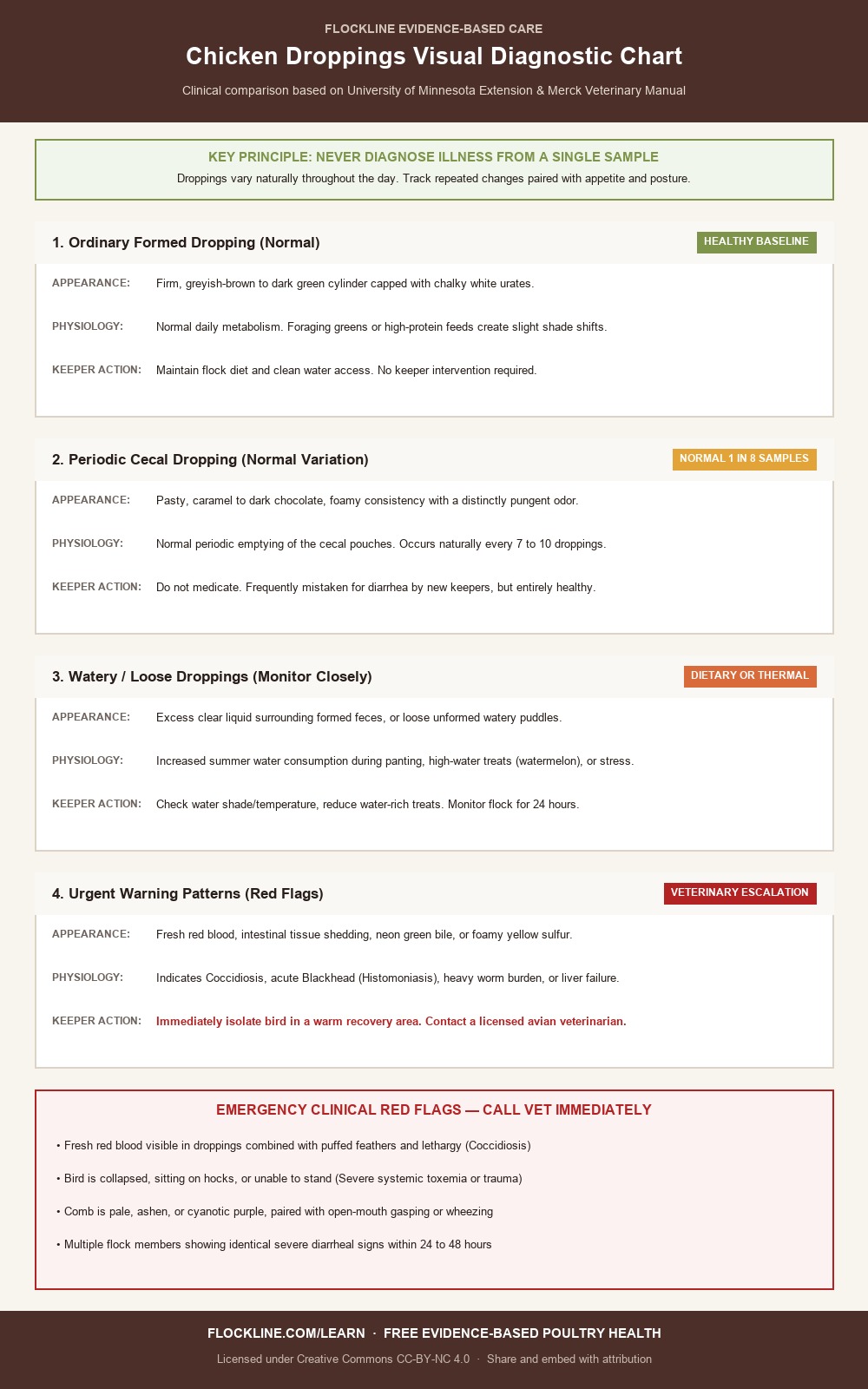
Compare patterns, not one dramatic photo
Droppings change through the day, and a single sample may not belong to the bird you are worried about. Start by confirming the bird, time, and whether the appearance repeats. Use a clean disposable surface or a fresh section of bedding for observation, then wash your hands and clean equipment.
University of Minnesota Extension describes healthy droppings as firm, greyish brown with white urates. It also notes that roughly every tenth dropping may be a foamy, smellier, light-brown cecal dropping. This normal variation is why a single image is not enough to diagnose illness.
Flockline droppings observation matrix
Ordinary formed
- Describe
- Firm, grey to brown, with white urates
- Check
- Bird is acting, eating, and drinking normally
- Action
- Keep the bird’s normal baseline
Periodic cecal
- Describe
- Softer, foamy, smellier, light brown
- Check
- Occasional rather than every dropping
- Action
- Record if uncertain, especially with other changes
Repeated watery change
- Describe
- How much liquid, colour, material, and frequency
- Check
- Appetite, drinking, heat, energy, and other birds
- Action
- Seek veterinary advice if persistent, worsening, or combined with illness signs
Warning combination
- Describe
- Blood or marked colour change plus the whole-bird signs
- Check
- Weakness, collapse, breathing, neurologic signs, multi-bird pattern
- Action
- Prompt veterinary or animal-health guidance
The matrix describes observations only. It does not identify a disease from colour or texture. The clinical illustration set remains unpublished until veterinary review.
How to make a useful droppings record
Include one uncropped context photo and one closer photo, with a common object for scale if safe. Record date, time, bird identity, the last observed normal dropping, food and water intake, behaviour, and whether the same change appears elsewhere in the flock.
When a droppings change is urgent
Seek urgent veterinary help if the bird collapses or cannot stand, has extreme difficulty breathing, uncontrolled bleeding, seizures or other marked neurologic signs, or is worsening quickly. Sudden illness or death in several birds, especially with respiratory, neurologic, swelling, or diarrhea signs, also needs prompt professional and local animal-health guidance.
What owners usually notice next
Choose the observation that most closely matches what you can see now. If urgent signs are present, contact a veterinarian rather than continuing through the guides.
- The bird is also quiet or not eatingUse the broad triage sequence and record the timing.
- The tail or stance also changedCompare the bird’s side profile, walking, and breathing.
- The comb also looks paleRecheck in even light and add that observation to the record.
- The pattern is unclearUse the checker to organise observations, not to diagnose from colour.
FAQ
Is every watery dropping diarrhea?
No. Describe how often it repeats and the material present, then consider the bird’s behaviour and other signs.
Is a soft brown dropping always abnormal?
No. Periodic cecal droppings can be softer, smellier, foamy, and light brown.
Can a poop chart diagnose coccidiosis?
No. Appearance alone cannot confirm coccidiosis or another disease. Diagnosis may require examination and testing.
Should I wait for several abnormal droppings?
Do not wait if blood, marked weakness, collapse, breathing difficulty, neurologic signs, or rapid multi-bird illness is present.
Sources and references
- University of Minnesota Extension: Raising Chickens for Eggs — Normal Cecal Droppings Protocol.
- Merck Veterinary Manual: Physical Examination of Backyard Poultry.
- USDA APHIS Defend the Flock: Recognizing Signs of Avian Disease.