
How to Protect Chickens from Foxes: Secure Housing and Habits
Quick answer
To protect chickens from foxes, lock birds in a hardware-cloth-secured coop at night, harden the run against digging and weak mesh, and eliminate easy climb or gap entries. Free range raises risk and needs extra planning.
Quick facts
| Primary job | Stop fox losses with night lockup discipline plus housing that survives a dig test |
|---|---|
| Night lockup | Fox pressure often peaks around dawn and dusk; secure nights are mandatory |
| Mesh | Hardware cloth standards over chicken wire |
| Digging | Aprons or buried barriers matter along soft edges |
| Build detail | Construction specs live in predator-proof chicken run |
| Raccoons differ | Also harden latches: raccoon proof coop |
| Free range | Higher risk; see chicken free range |
| Wildlife context | California DFG red fox overview · NY DEC red fox fact page |
How to protect chickens from foxes is mostly housing and habits, not a single scare device. Foxes exploit gaps, weak wire, dig lines, and birds left out after dark. Start with night lockup you can keep forever, then harden the coop and run so a curious dig does not become a massacre.
This page is the fox-intent sibling of the run build guide. If you need lumber, mesh schedules, and failure-point diagrams for the enclosure itself, use predator proof chicken run. Raccoon latch problems overlap but are not identical; see raccoon proof chicken coop.
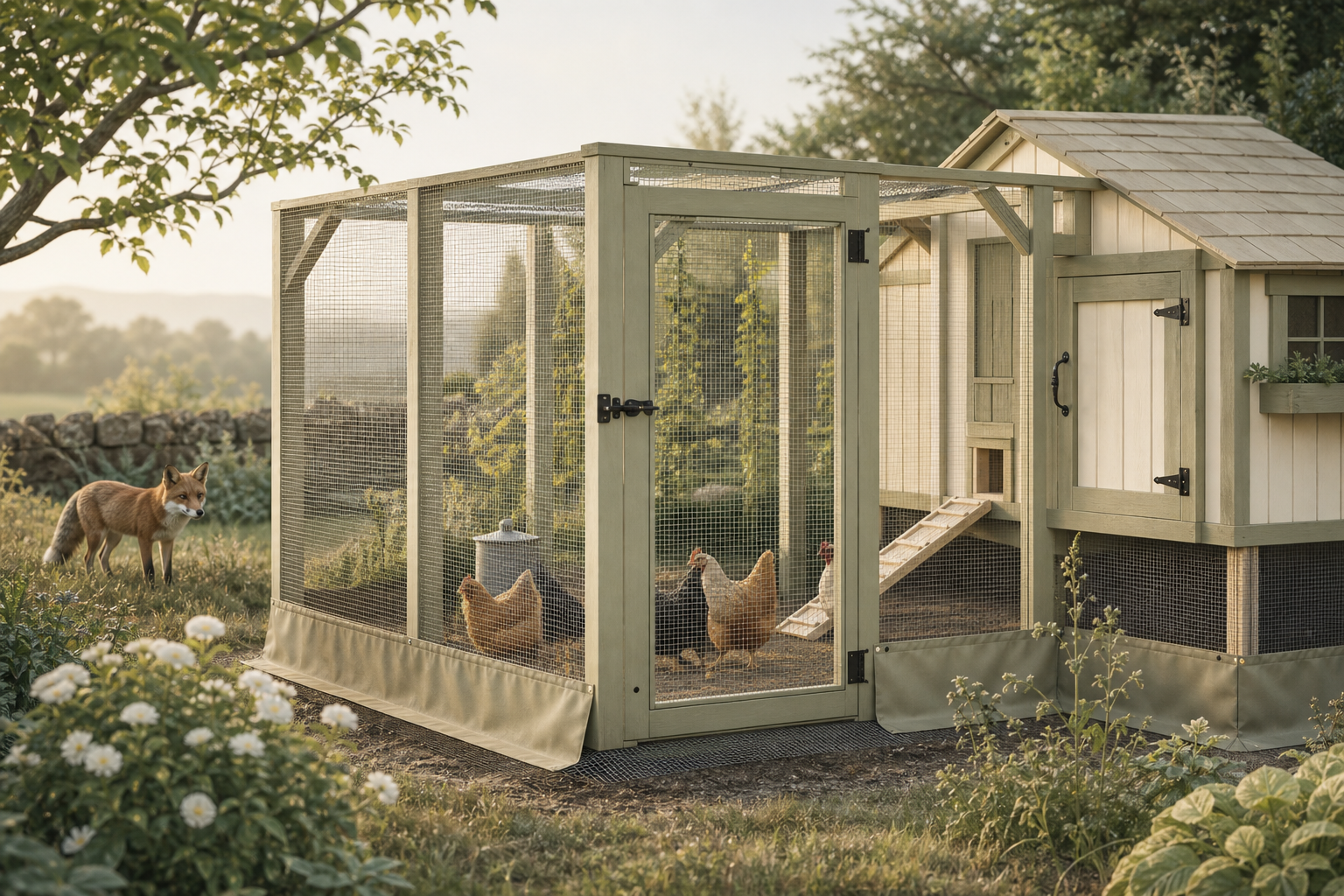
Secure nights first (the fox rule)
Birds should sleep in a finished coop with screened openings and solid latches. Dusk lockup is a rule, not a vibe. Fox activity often rises when light fades and again near dawn, which is exactly when tired keepers cut corners. Automatic doors help when they close fully into an already secure structure. They do not invent security that is not there.
Put the routine on your phone until it is muscle memory. Count birds at the pop door. If one is missing, you want to know before full dark, not after a loss.
Housing that survives a dig test
Replace chicken wire with hardware cloth on vulnerable panels. Add dig aprons or buried barriers, especially at corners and gate thresholds. The detailed install mistakes and roll planning live in hardware cloth for chicken coops and the predator-proof run build guide. Foxes test the cheapest edge. Your job is to make that edge expensive.
For materials, a straightforward starting point is galvanized 1/2-inch hardware cloth stiff enough to hold shape. One concrete retail example is this hardware cloth roll listing; match opening size and gauge to your framing before you order. Pair mesh with latch hardware you cannot open sleepily at dawn.
Why foxes keep winning against soft setups
Wildlife agencies describe red foxes as adaptable mesopredators that use cover, edges, and opportunistic hunting. You do not need a wildlife degree to act on that: tidy runs with soft wire, propped doors, and birds lingering outside at dusk are invitations. For natural-history context (not a husbandry recipe), skim the California red fox overview or the NY DEC red fox page, then come back to your latch and dig line.
Daytime and free-range risk
Enclosed runs reduce exposure. Free range can work on some properties with supervision, livestock guardian strategies, or heavy cover, and it can fail quickly on others. Treat free range as an advanced choice, not a default. Range freedom is not free of fox math. Read the tradeoffs in chicken free range before you romanticize open pasture.
Inspect like a predator
Walk the perimeter monthly. Push on panels. Check under gates with a flashlight. Repair popped staples. After storms, re-audit before the next night. Fresh soil piles along an edge are a message, not scenery.
Overlap with other predators
Upgrades for foxes often help against other climbers and diggers, but raccoon dexterity still demands better latches (raccoon proofing). Do not assume a fox-focused dig apron alone solves a raccoon that opens simple twist locks.
Fox protection checklist
Use this as a weekly habit audit. Check items in order, note what fails, and fix failures before buying another gadget.
Progress saves in this browser. Print this page or download the PDF for a paper copy.
Common mistakes
- Leaving birds out at dusk during fox pressure.
- Chicken wire as the only barrier.
- No dig defense on the run perimeter.
- Assuming daytime is always safe.
- Skipping lockup training until a loss teaches the lesson.
- Ignoring soft latches and nest doors.
FAQ
How do I protect chickens from foxes?
Secure night housing with hardware cloth, dig defense, solid latches, and disciplined lockup. Build details live in the predator-proof run guide.
Will a fence alone work?
Only if it is predator-resistant in mesh, height, and dig defense, and birds still lock in at night.
Is free range safe?
It raises risk. Use only with strong night housing and a site-specific plan.
Do foxes climb?
They exploit gaps and weak points; design as if they will test edges and dig lines.
What mesh?
Hardware cloth standards, not chicken wire alone.
What about raccoons?
Add latch hardening; see the raccoon guide.
Sources and further reading
- NC State Extension: Keeping Garden Chickens in North Carolina
- University of Georgia Extension publication B1317
- California Department of Fish and Wildlife: Red Fox
- New York DEC: Red Fox
- eXtension poultry resource hub (poultry.extension.org)
- Example retail listing: hardware cloth roll (confirm opening size and gauge before you buy)
- Flockline Learn related guides linked in this article.
- Community patterns synthesized from public backyard-poultry discussions; individual forum URLs are not cited because they rot and anecdotes vary.