
Chicken Free Range: Benefits, Risks, and a Safer Setup
Quick answer
Chicken free range means birds forage outside a fixed run for part of the day. It can improve enrichment and forage access, and it increases predator and neighbor-risk exposure. Secure night housing remains mandatory.
Quick facts
| Definition | Daytime access beyond a fixed enclosed run |
|---|---|
| Benefits | Enrichment, forage, insect hunting, lower boredom pecking for some flocks |
| Risks | Foxes, dogs, hawks, traffic, toxic plants, neighbor conflicts, theft |
| Night rule | Always lock into a secure coop before dusk pressure rises |
| Prereq | Finished housing first: predator-proof run and hardware cloth |
| Not required | Free range is optional risk management, not a moral scorecard |
Chicken free range is daytime freedom outside a fixed run. It is not required for ethical keeping, and it is not free of consequences.
Only consider it after a secure coop exists, preferably with a solid run as a fallback for hawks, dogs, and bad-weather days. Keep nights locked. Train returns. Young chicks need staged outdoor rules in when chicks can go outside.
What people want from range
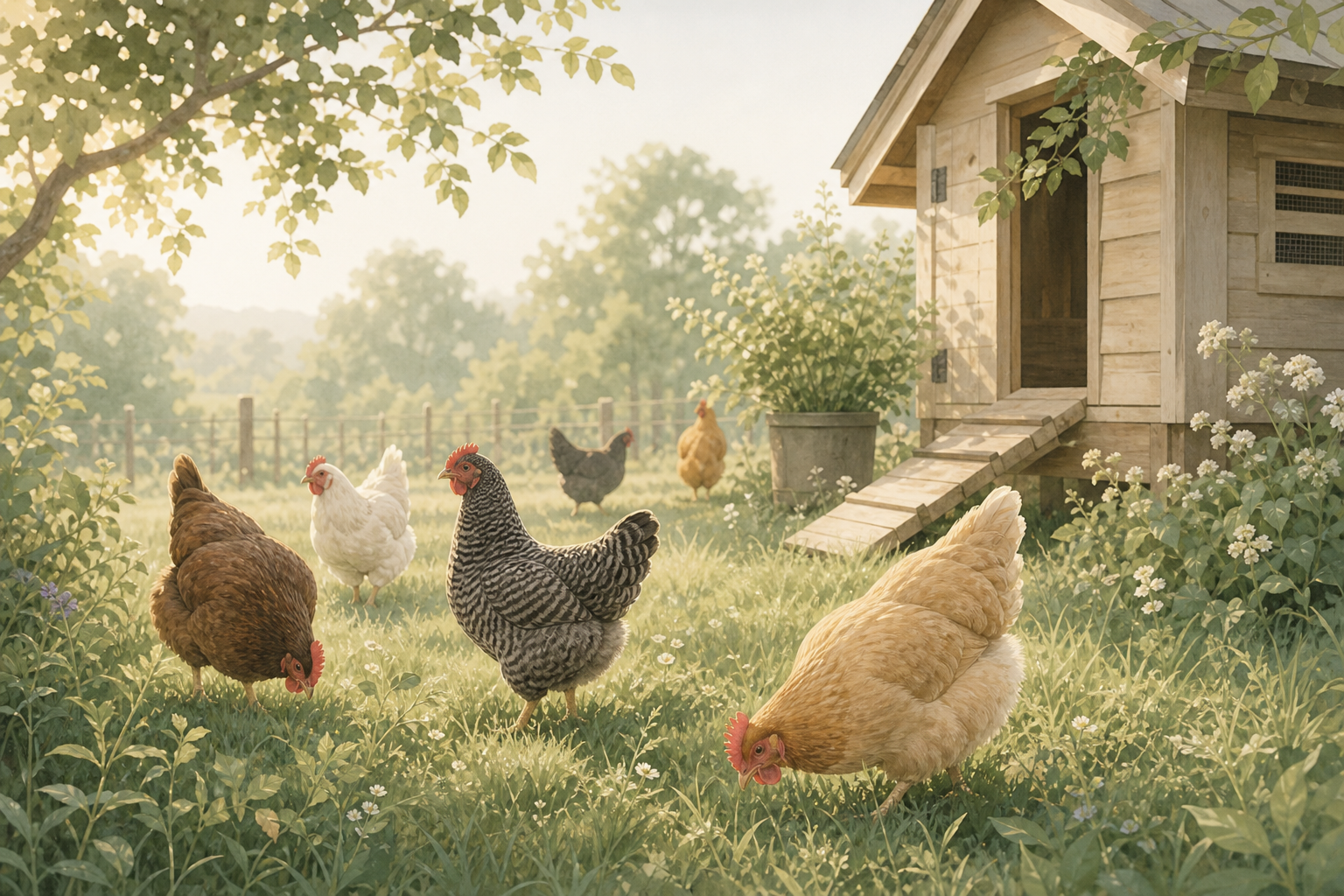
Forage, insects, space to express normal behaviours, and reduced boredom can improve welfare for some flocks on suitable properties. Birds that spend hours scratching often look busier and less interested in picking on flockmates.
A dust bath habit still belongs at home (chicken dust bath). Range is enrichment, not a substitute for dry housing, nests, or mesh standards. If your yard is a predator freeway, a larger secure run may deliver more of the welfare benefit with less grief.
Risks to name out loud
Foxes, raccoons at dusk edges, hawks, loose dogs, theft, poisonous plants, roads, and angry neighbors are common failure modes. “We have never seen a fox” is not a security plan. See fox protection and raccoon proofing for housing baselines that must still exist even if birds spend afternoons outside.
Biosecurity also changes with range. Birds meet wild bird droppings, puddles, and whatever wandered through overnight. That does not forbid free range. It does mean you should stop romanticizing it as risk-free nature.
Prerequisites before the first open gate
- Predator-resistant night coop with solid latches and screened openings.
- Reliable dusk return training (birds that come home when called or when the feeder appears).
- A secure run as fallback for weather, hawks, and days you cannot supervise.
- Property boundaries and neighbor realities you understand (gardens, dogs, HOA rules).
If any of those four is missing, finish housing first. The predator-proof chicken run guide covers mesh, roof, and dig failure points.
How to trial without romanticizing it
Start supervised short sessions after birds know the coop as home. Expand slowly. Pause during predator surges, confusing deep snow, heavy molt, or when a neighbor’s dog is loose again.
Free range is a dial, not a permanent switch branded as “natural.” Many keepers range mid-day only, lock earlier in winter, or skip range entirely during known fox pressure. That is competent management, not failure.
Housing still matters at dusk
Ventilation, bedding, nests, and mesh remain daily infrastructure: ventilation, bedding, nesting boxes. Range time does not forgive a wet ammonia box at night.
Automatic doors help only if they close fully and the coop behind them is already predator resistant. A door that closes on a chicken-wire box is still a soft target.
Common mistakes
- Free ranging without a secure coop because the yard “feels safe.”
- Leaving birds out at dusk “just this once.”
- No fallback run when hawks or dogs show up.
- Treating free range as mandatory for “happy chickens.”
- Skipping return training until you are chasing birds at dark with a flashlight.
FAQ
What is chicken free range?
Daytime access outside a fixed enclosed run.
Is free range better?
It can enrich birds and it raises risk. It is optional.
Do I still need a coop?
Yes. Secure nights are mandatory.
How do I start?
Supervised short sessions after housing and return training are solid.
What if my property has heavy predator pressure?
A larger secure run may be the better welfare trade than unsupervised range.
Sources and further reading